Distance Learning or Regular College? What Employers Prefer in 2025
Is a distance degree valid for a job in 2025? Get real facts on distance education recognition & online degree job value. Build confidence in your online education.
Shakhi Singh
Content Writer
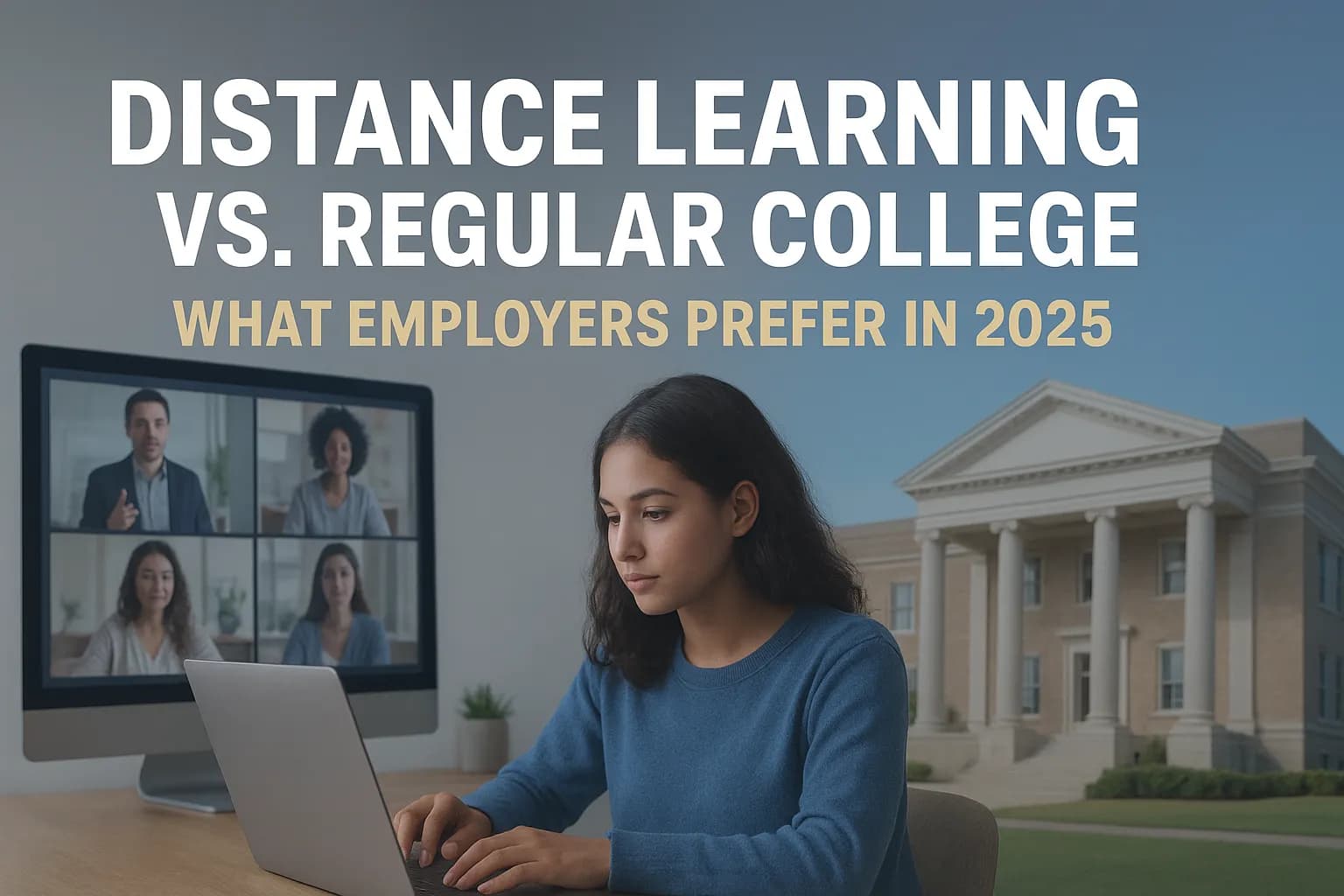
The short answer for 2025 is clear: Employers increasingly value the skills you possess and the quality of the institution more than the delivery format of your degree. A traditional degree from a top university remains highly respected, but an accredited online degree from a reputable school is now often viewed as its equal. A 2025 global education report notes that 83% of HR professionals see an accredited online degree as equal to a traditional one, and over 75% of employers hired online degree holders in the past year. The pandemic normalized digital work and learning, dissolving the old stigma. Ultimately, if your degree is from a recognized university and you bring in-demand skills like digital proficiency, self-motivation, and work ethic, your distance education recognition is strong and the online degree job value is high.
The Evolving Landscape of Education: The Digital Shift
The world of work and education has transformed dramatically over the last few years. The sudden, forced global shift to remote operations and learning fundamentally changed how employers view remote skills and virtual collaboration. This change has been a massive, permanent boost for distance learning.
The online degree market is on a rapid growth trajectory, forecasted to reach an estimated $74 billion in 2025, according to education market insights. This demonstrates the sheer scale, trust, and growing demand for this flexible educational model. This is not a temporary trend; it is a structural change in higher education, making quality education more accessible and geographically flexible than ever before.
Post-Pandemic Normalization: The End of the Stigma
For decades, a small, stubborn stigma was sometimes attached to degrees earned outside the traditional physical campus setting. However, the events of the last few years have completely broken down this barrier.
- Mass Adoption: When nearly all universities, including the world's most prestigious institutions, were forced to move their classes online, employers realized that the quality of education was intrinsically linked to the university’s rigor, faculty, and curriculum, not the physical location of the classroom.
- Employer Confidence: Studies confirm this change in attitude. A survey by the Society for Human Resource Management (SHRM) revealed that 79% of employers had hired someone with an online degree in the past year, while other research found that a large majority of HR professionals rated the quality of online degrees as equal to or even better than traditional degrees.
- Skill Relevance: The very skills you must master to succeed in a distance learning program including self-discipline, time management, digital communication, and technical adaptability are now core competencies required for success in the modern, often hybrid, workplace. Employers now actively seek candidates who possess this demonstrated proficiency.
Distance Education Recognition: Is a Distance Degree Valid for a Job?
This is the foundational question for anyone considering an alternative path. The answer is an unambiguous yes, a distance degree is valid for a job, provided you make a conscious choice to select an officially recognized and accredited program.
Accreditation is Key, Not the Format
Hiring managers in 2025 focus on three main pillars when assessing your academic credentials, regardless of whether you studied on-campus or remotely:
- Accreditation (The Stamp of Quality): Is the university and the specific program legally recognized by the relevant educational authorities? In many regions, bodies like the UGC-DEB (University Grants Commission – Distance Education Bureau) or their international equivalents (regional accreditation bodies in the US) ensure academic standards are met. Accreditation is the single most important factor that assures quality and grants official validity.
- School Reputation (The Brand Trust): A degree from a highly respected, well-known university even if studied online, carries immense weight. Many top universities offer online programs that award the exact same diploma as their on-campus counterpart, meaning the degree’s value is identical.
- Skills and Experience (The Proof of Impact): As the job market evolves, employers hire for impact, not attendance. They look for demonstrable, practical applications, such as successful capstone projects, relevant internships (even virtual ones), and professional certifications that prove you can deliver results on the job.
- Validity for Government Jobs: For those aiming for government jobs or national competitive exams, the rules are clear. Degrees obtained through the Online and Open and Distance
- Learning (ODL) mode from UGC-recognized universities are considered equivalent to a regular degree and are fully valid for government jobs and further studies.
Geographical Flexibility and Global Mobility
For candidates in 2025, distance learning provides a crucial geographical advantage, making it highly and globally relevant. This is particularly transformative for regions outside major metropolitan centers.
- Access to Top Institutions: A prospective student in a remote, underserved area can now earn a degree from a top-tier, globally recognized university without the financial burden or logistical complexity of relocating. This massive democratization of quality education is an economic and social equalizer.
- Remote Work Alignment: With a Gallup study indicating that a large percentage of employees capable of remote work operate in a hybrid or fully remote setting, distance graduates are already masters of the required work culture. Their degrees naturally align with globally distributed teams and remote job opportunities, making them highly attractive to companies with a wide geographical footprint.
- International Career Acceptance: For reputable, accredited online degrees, the qualification is widely accepted internationally, especially in global high-demand fields like IT, Data Science, and Business. When a company is hiring for an overseas role, they prioritize the candidate's skills and the accreditation of the issuing institution, not the physical campus location.
What Employers Really Look For Beyond the Degree
In the competitive job market of 2025, the conversation has moved past "How did you study?" to "What can you do for our business?" Employers, particularly in large corporations and fast-growing tech sectors, are looking for the total package.
1. Proof of Concept (The Portfolio)
For technology, design, and increasingly, marketing and business roles, a well-built portfolio is your most valuable asset.
- Tech Roles: Show your GitHub repository, working application demos, and complex data analysis projects. A degree gets you the interview; the portfolio gets you the job.
- Business/Management Roles: Present a detailed case study from your course or work, showcasing how you solved a real-world business problem, managed a virtual, cross-cultural team, or developed a measurable strategic plan.
2. Lifelong Learning & Certifications
The commitment to continuous learning is critical. Distance learners, who often seek education while working, demonstrate this commitment naturally, signaling adaptability to change.
- Micro-Credentials: Specialized certifications such as Google Analytics, AWS Cloud Practitioner, or a Project Management certification serve as powerful complements to a formal degree, instantly validating a niche, in-demand skill.
- Agility and Curiosity: The World Economic Forum’s analysis for 2025 highlights that "creative thinking, resilience, flexibility and agility, along with curiosity and lifelong learning," are essential skills for navigating the rapid pace of technological change. Choosing distance education demonstrates you already possess these traits.
3. Cultural Fit and Soft Skills
While technical knowledge is the entry ticket, the ability to collaborate and lead gets you the job and promotions.
- Collaboration: Be ready to discuss specific, successful examples of how you collaborated effectively on group projects using virtual tools like shared documents and video conferencing.
- Resilience and Maturity: Successfully completing a demanding online degree while managing a job or family is an inherent testament to your high work ethic and maturity. Share stories that highlight your ability to overcome challenges and manage competing, complex priorities.
Overcoming the Residual Bias: Your Strategy
Despite the overwhelming statistics in favor of the strong distance education recognition in 2025, you might occasionally encounter a traditional hiring manager with an outdated bias. Here's your simple, powerful strategy:
- Be Proactive in Your Resume: Don't hide the format; embrace its value. List your degree clearly, but immediately follow it with an achievement that highlights rigor and discipline.
- Example: BBA (Online, UGC-DEB Approved) from XYZ University, 2025. Graduated with Distinction; Successfully launched a regional e-commerce initiative as the capstone project while working full-time.
- Focus the Interview on Results: When asked about your choice, pivot quickly from the format to the results.
- Say This: "I chose the accredited online program from XYZ University because it allowed me to simultaneously gain practical, current experience in my full-time role. I was applying the Financial Modeling techniques from the classroom to real-world business reports the very next day, which resulted in a more relevant and impactful learning process."
- Leverage Your References: Ensure your references are prepared to speak not just about your academic performance, but specifically about the excellent digital communication, self-discipline, and strong work ethic you displayed while managing the dual demands of remote learning and professional life.
Conclusion
The debate between distance learning and regular college is functionally over in 2025. Employers have moved past the "where" and are fundamentally focused on the "what" (your skills) and "who" (your character). The demand for education that allows people to earn and learn simultaneously is skyrocketing, making an accredited distance degree a strategic and highly viable path for career growth, promotions, and career switches. Your online degree job value is determined by your strategic choice of a respected, accredited institution and your ability to showcase your hard-earned skills. The distance education recognition is stronger and more widespread than ever before.
Trust the data, choose a quality, accredited program, and lead with your skills.
Ready to Find Your Accredited Online Degree Program? Take the next step towards a future where your education fits your life, not the other way around. Explore Top-Rated Accredited Online Degrees and Career Paths Today!
FAQs about Comparison
Are degrees obtained through distance education truly valid for all government jobs in 2025?
Yes, degrees from UGC-DEB approved Open and Distance Learning (ODL) programs are considered equivalent to regular degrees and are fully valid for all government and private sector jobs in 2025.
Does studying online affect my chances of getting hired by a major multinational company (MNC)?
No, major MNCs prioritize accreditation, transferable digital skills, and a strong portfolio; an accredited online degree is generally viewed as equal to its traditional counterpart.
Which specific online degrees are employers most interested in for 2025?
Degrees in high-demand, digitally focused fields such as Data Science, Computer Science, Online MBA with niche specializations, and Cybersecurity are the most sought after.
Is there a difference between "Online Learning" and "Distance Education" degrees for job value?
Modern "Online Learning" is often preferred as it typically involves more rigorous, interactive, real-time virtual classes, which better demonstrates essential digital communication skills than traditional self-paced distance education.
Do I lose valuable professional networking opportunities by choosing an online program?
While face-to-face networking is reduced, you gain opportunities to network globally with a diverse cohort and must actively use professional platforms like LinkedIn, demonstrating crucial modern networking skills.