DM Full Form: District Magistrate — Role, Salary, Powers & How to Become
DM full form is District Magistrate. Learn about DM salary (₹1L+/month), powers, responsibilities, UPSC IAS path to become DM, and difference between DM, DC, and Collector.
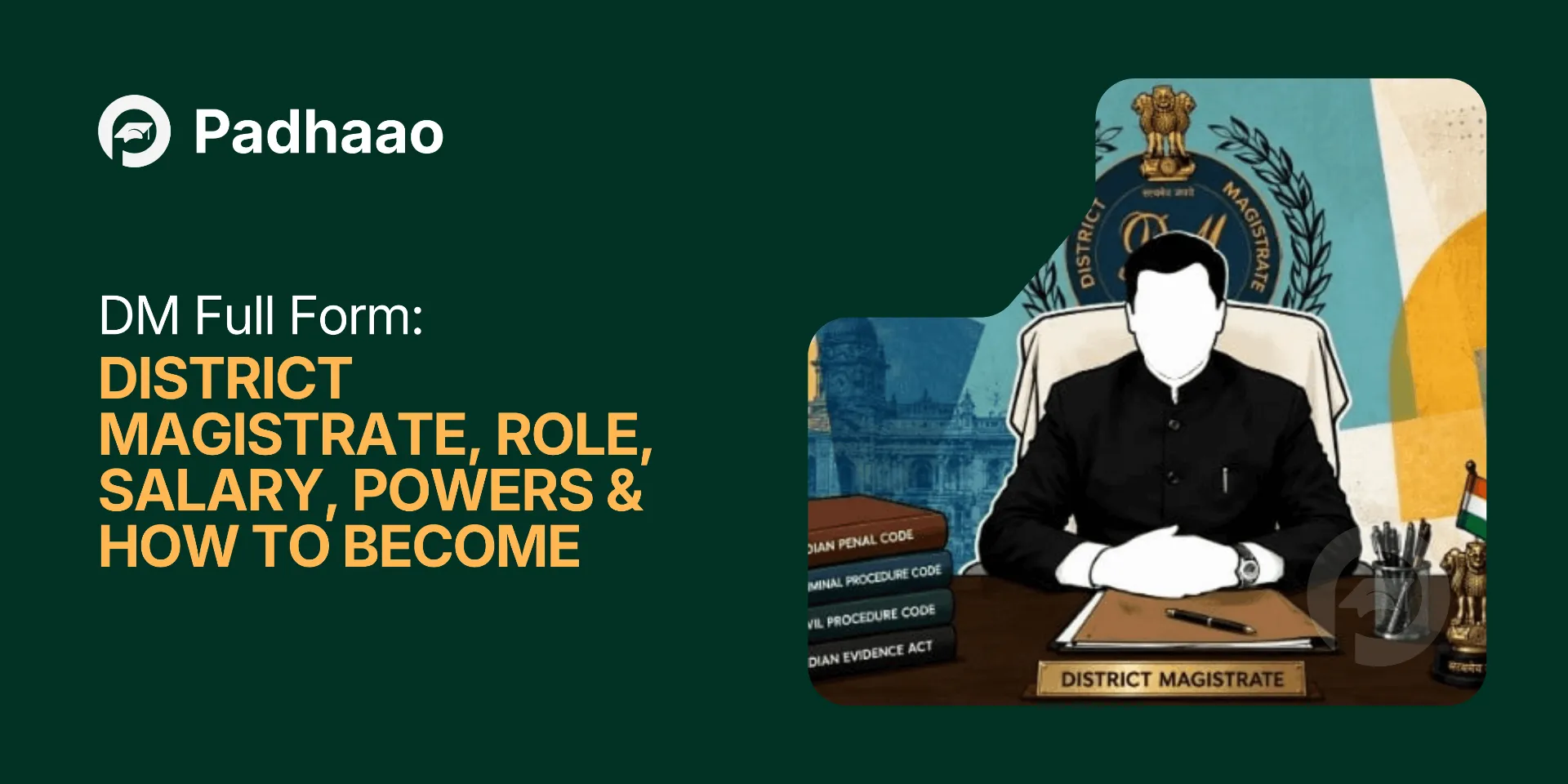
DM stands for District Magistrate — the most powerful administrative officer at the district level in India. The DM (also called District Collector or Deputy Commissioner in some states) is responsible for law and order, revenue collection, development programmes, and disaster management in an entire district.
Becoming a DM is one of the most prestigious career goals in India. It requires clearing the UPSC Civil Services Examination (CSE) and getting into the Indian Administrative Service (IAS). This guide covers everything about the DM role — full form, salary, powers, how to become one, and what the job actually looks like.
DM Full Form & What a District Magistrate Does
DM = District Magistrate. In some states, the same officer is called District Collector (DC) or Deputy Commissioner. All three titles refer to the same IAS officer who heads a district’s administration.
| Parameter | Details |
|---|---|
| Full Form | District Magistrate |
| Other Titles | District Collector (DC), Deputy Commissioner |
| Service | Indian Administrative Service (IAS) |
| Appointed By | State Government (from IAS cadre) |
| Reports To | Divisional Commissioner |
| Jurisdiction | One district (population 10L–50L typically) |
| Entry Route | UPSC CSE → IAS → District posting |
| Salary (Entry) | ₹56,100–1,31,100/month + allowances |
| Total In-Hand | ₹1–1.5 Lakh/month (with HRA, DA, etc.) |
The DM is essentially the CEO of a district. They oversee all government departments, coordinate between state and central government schemes, handle elections, manage natural disasters, maintain law and order (as District Magistrate), and collect land revenue (as Collector).
DM Salary & Benefits 2026
| Pay Level | Basic Pay | Total Monthly (with DA, HRA) | When You Reach This Level |
|---|---|---|---|
| Level 10 (Junior) | ₹56,100 | ₹1–1.2 LPA equivalent/month | First posting (SDM level) |
| Level 11 (DM/DC) | ₹67,700 | ₹1.2–1.5L/month | 4–8 years (first DM posting) |
| Level 13 (Commissioner) | ₹1,23,100 | ₹2–2.5L/month | 12–16 years |
| Level 14 (Principal Secy) | ₹1,44,200 | ₹2.5–3L/month | 20+ years |
| Level 17 (Cabinet Secy) | ₹2,50,000 | ₹4L+/month | 30+ years (top 1%) |
Beyond salary, the perks are massive: government bungalow (5–10 BHK), official car with driver, domestic staff, security, free medical treatment, children’s education allowance, and pension for life after retirement. The total compensation package of a DM is worth ₹30–40 LPA when you include all perks.
Career Outcomes
Career & Placement Overview — Education Graduates
Average Package
₹5 – 12 LPA
Post-graduation median salary
Highest Package
₹20 – 40 LPA
Top offers from premium recruiters
Salary Hike
25 – 60%
Reported within 2 yrs of graduation
Hiring Partners
300+
Across industries & cities
How to Become a DM — Step-by-Step Path
There’s only one path to becoming a District Magistrate:
- Complete graduation in any stream (BA, B.Sc, B.Tech, B.Com, LLB — any degree works)
- Clear UPSC Civil Services Exam (CSE) — India’s toughest exam with 3 stages:
- Prelims: 2 objective papers (GS + CSAT), qualifying stage
- Mains: 9 descriptive papers including essay, GS (4 papers), optional subject (2 papers)
- Interview: Personality test by UPSC board (275 marks)
- Get IAS (Indian Administrative Service) allotment — you need to rank in the top 100–150 to get IAS. Lower ranks get IPS, IFS, IRS etc.
- Complete training at LBSNAA Mussoorie — 2-year foundation + professional training
- Serve as SDM (Sub-Divisional Magistrate) for 4–6 years
- Get posted as DM/DC — typically after 6–10 years of service
Age limit: 21–32 years for General, 35 for OBC, 37 for SC/ST. You get 6 attempts (General), 9 (OBC), unlimited (SC/ST) until age limit. Most successful candidates clear it by their 2nd–3rd attempt.
DM vs DC vs Collector — What’s the Difference?
| Title | Used In | Same Officer? | Key Role |
|---|---|---|---|
| District Magistrate (DM) | UP, Bihar, MP, Rajasthan, WB | Yes | Law & order, judicial magistrate powers |
| District Collector (DC) | Tamil Nadu, Maharashtra, Karnataka, AP | Yes | Revenue collection, land administration |
| Deputy Commissioner | Punjab, Haryana, NE states | Yes | Combined DM + DC functions |
All three titles refer to the same IAS officer. The title varies by state due to historical reasons. The officer performs both magisterial (law & order) and revenue (land/tax) functions regardless of which title is used.
Frequently Asked Questions
What is the full form of DM?
What is the salary of a DM in India?
How to become a DM?
What is the difference between DM and DC?
Is DM and IAS the same?
Recommended Articles
IPS Full Form: Indian Police Service — Salary, Training, Rank & How to Become IPS Officer
PCS Full Form: Provincial Civil Service — Exam, Salary, Eligibility & UPPSC Guide

LLB Course Details 2026: Full Form, Eligibility, Fees, Subjects & Career Scope

CSE Full Form: Computer Science and Engineering — Course, Salary, Scope & Career

Nursing Salary in India 2026: BSc Nurse, GNM, ANM — Government vs Private Hospital Pay