Online BBA vs BCA: Which Course is Better for Your Career in 2026?
BBA vs BCA — compare fees, salary, career scope, and subjects. Which online undergraduate course is right for you? Complete 2026 guide.
BBA and BCA are the two most popular online undergraduate degrees in India after BA. Both are 3-year programmes, both cost roughly the same, and both lead to decent careers. But they prepare you for very different paths.
If you're confused between the two, this guide will help you decide based on your interests, career goals, and the kind of work you actually want to do after graduation.
BBA Course — Complete Details
BBA (Bachelor of Business Administration) is a management-focused undergraduate degree. It's designed for students who want to understand how businesses work — from marketing and sales to finance and human resources. Think of it as a foundation course for future managers and entrepreneurs.
- Year 1: Principles of Management, Business Communication, Financial Accounting, Business Economics, Computer Applications for Business, Business Mathematics
- Year 2: Marketing Management, Human Resource Management, Organizational Behaviour, Business Law, Cost Accounting, Production & Operations Management, Business Statistics
- Year 3: Strategic Management, Financial Management, Entrepreneurship Development, International Business, Business Ethics & Corporate Governance, Capstone Project + Electives
BBA Course Subjects (Semester-wise breakdown):

- Year 1: Principles of Management, Business Communication, Financial Accounting, Business Economics, Computer Applications for Business, Business Mathematics
- Year 2: Marketing Management, Human Resource Management, Organizational Behaviour, Business Law, Cost Accounting, Production & Operations Management, Business Statistics
- Year 3: Strategic Management, Financial Management, Entrepreneurship Development, International Business, Business Ethics & Corporate Governance, Capstone Project + Electives
The electives in Year 3 let you specialize in areas like Digital Marketing, Banking & Insurance, Retail Management, or International Trade. This specialization helps shape your career direction after graduation.
BBA Course Duration: 3 years (6 semesters). Some universities allow completion in up to 6 years for students who need extra time.
- IGNOU BBA — Rs 21,600 total (Rs 3,600/semester). Cheapest option, no live classes.
- LPU Online BBA — Rs 60,000-1,00,000 total. NAAC A++, live classes, placement support.
- Chandigarh University Online BBA — Rs 75,000-1,10,000 total. NAAC A+, strong digital infrastructure.
- Jain University Online BBA — Rs 90,000-1,20,000 total. NAAC A++, Bangalore tech ecosystem.
- Amity University Online BBA — Rs 1,05,000 total. NAAC A+, QS World Ranked, WES recognized.
- DY Patil Online BBA — Rs 80,000-1,10,000 total. NAAC accredited, strong in Maharashtra.
- Manipal University Online BBA — Rs 1,00,000-1,50,000 total. NAAC A++, IIRF ranked.
BBA Course Fees at Top Online Universities:
- IGNOU BBA — Rs 21,600 total (Rs 3,600/semester). Cheapest option, no live classes.
- LPU Online BBA — Rs 60,000-1,00,000 total. NAAC A++, live classes, placement support.
- Chandigarh University Online BBA — Rs 75,000-1,10,000 total. NAAC A+, strong digital infrastructure.
- Jain University Online BBA — Rs 90,000-1,20,000 total. NAAC A++, Bangalore tech ecosystem.
- Amity University Online BBA — Rs 1,05,000 total. NAAC A+, QS World Ranked, WES recognized.
- DY Patil Online BBA — Rs 80,000-1,10,000 total. NAAC accredited, strong in Maharashtra.
- Manipal University Online BBA — Rs 1,00,000-1,50,000 total. NAAC A++, IIRF ranked.
Fee Comparison
Estimated Fee Structure — Course&College (2026)
2 Years
2 Years
2 Years
Who Should Choose BBA?
BBA is right for you if: you enjoy reading about business and current affairs, you're a people person who likes working in teams, you see yourself in management or leadership roles, you want to pursue MBA later, or you're interested in starting your own business someday. BBA doesn't require strong math skills — business math is much simpler than engineering math.
BCA Course — Complete Details
BCA (Bachelor of Computer Applications) is a technology-focused undergraduate degree. It's the IT industry's equivalent of what BBA is for management. BCA teaches you programming, software development, database management, and the fundamentals of how computer systems work.
- Year 1: Programming in C, Digital Electronics, Mathematical Foundations, PC Software & Office Automation, English Communication, Computer Organization
- Year 2: Data Structures, Object-Oriented Programming (Java/C++), Database Management Systems (DBMS), Operating Systems, Computer Networks, Software Engineering, Web Technologies (HTML, CSS, JavaScript)
- Year 3: Python Programming, Cloud Computing basics, AI/ML Introduction, Mobile App Development, Cyber Security fundamentals, Project Work + Electives
BCA Course Subjects (Semester-wise breakdown):
- Year 1: Programming in C, Digital Electronics, Mathematical Foundations, PC Software & Office Automation, English Communication, Computer Organization
- Year 2: Data Structures, Object-Oriented Programming (Java/C++), Database Management Systems (DBMS), Operating Systems, Computer Networks, Software Engineering, Web Technologies (HTML, CSS, JavaScript)
- Year 3: Python Programming, Cloud Computing basics, AI/ML Introduction, Mobile App Development, Cyber Security fundamentals, Project Work + Electives
BCA's curriculum has evolved significantly in recent years. Universities like Jain, LPU, and Manipal have added modules on AI, cloud computing, and DevOps that weren't part of BCA even 3-4 years ago.
BCA Course Duration: 3 years (6 semesters). Same flexibility as BBA for extended completion.
- IGNOU BCA — Rs 30,000-33,000 total. Slightly more expensive than IGNOU BBA because of the IT infrastructure component.
- LPU Online BCA — Rs 60,000-1,00,000 total. NAAC A++, modern curriculum with AI/ML modules.
- Chandigarh University Online BCA — Rs 80,000-1,20,000 total. NAAC A+, good practical lab components.
- Jain University Online BCA — Rs 90,000-1,10,000 total. NAAC A++, Bangalore IT corridor access.
- Amity University Online BCA — Rs 1,05,000 total. QS ranked, strong international recognition.
- Manipal University Online BCA — Rs 1,00,000-1,50,000 total. NAAC A++, IIRF ranked.
Confused about which course to pick?
Our counsellors have helped 10,000+ students choose the right program. Get a free 15-minute call — no pressure, no sales pitch.
BCA Course Fees at Top Online Universities:
- IGNOU BCA — Rs 30,000-33,000 total. Slightly more expensive than IGNOU BBA because of the IT infrastructure component.
- LPU Online BCA — Rs 60,000-1,00,000 total. NAAC A++, modern curriculum with AI/ML modules.
- Chandigarh University Online BCA — Rs 80,000-1,20,000 total. NAAC A+, good practical lab components.
- Jain University Online BCA — Rs 90,000-1,10,000 total. NAAC A++, Bangalore IT corridor access.
- Amity University Online BCA — Rs 1,05,000 total. QS ranked, strong international recognition.
- Manipal University Online BCA — Rs 1,00,000-1,50,000 total. NAAC A++, IIRF ranked.
Who Should Choose BCA?
BCA is right for you if: you enjoy problem-solving and logical thinking, you're curious about how apps and websites are built, you want to work in IT companies (TCS, Infosys, Wipro, startups), you like working independently on technical problems, or you want to pursue MCA or M.Sc Computer Science later. BCA does require comfort with mathematics — not at engineering level, but you need to handle discrete math and logic.
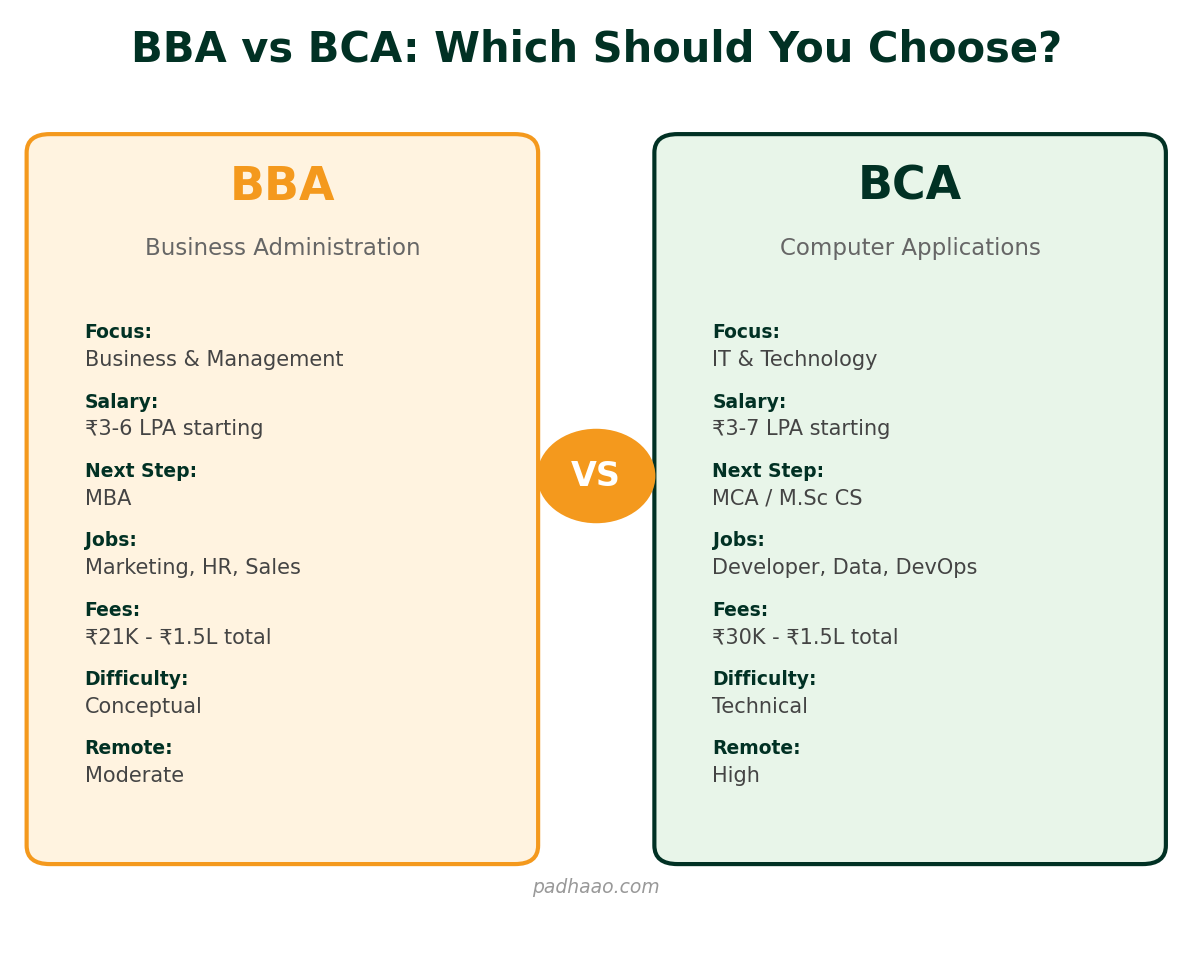 >
>| Parameter | BBA | BCA |
|---|---|---|
| Focus | Business & Management | IT & Technology |
| Duration | 3 years | 3 years |
| Starting Salary | Rs 3-6 LPA | Rs 3-7 LPA |
| Fees (Online) | Rs 21K-1.5L | Rs 30K-1.5L |
| Higher Studies | MBA | MCA / M.Sc CS |
| Job Demand (2026) | High | Very High |
| Difficulty | Conceptual | Technical |
| Remote Work Options | Moderate | High |
Compare courses: Online BBA Details | Online BCA Details | LPU Online BBA Review
1. Career Focus
BBA prepares you for management and business roles — marketing manager, HR executive, business analyst, operations coordinator, sales manager. BCA prepares you for technology roles — software developer, web developer, database administrator, system analyst, IT support engineer. The career paths barely overlap, so this is the most important differentiator.
Career Outcomes
Career & Placement Overview — Course&College Graduates
Average Package
₹8 – 15 LPA
Post-graduation median salary
Highest Package
₹25 – 45 LPA
Top offers from premium recruiters
Salary Hike
30 – 60%
Reported within 2 yrs of graduation
Hiring Partners
500+
Across industries & cities
2. Starting Salary
BBA graduates earn Rs 3-6 LPA starting in management roles. BCA graduates earn Rs 3-7 LPA starting (slightly higher average because IT companies pay well even at entry level). After 5 years, BBA professionals earn Rs 8-15 LPA while BCA professionals earn Rs 8-18 LPA. The BCA premium comes from the persistent demand for tech talent in India.
3. Job Market Demand
As of 2026, BCA graduates have a slight edge in job availability. India's IT sector employs over 5 million people and adds 200,000+ jobs annually. Management roles (BBA pathway) are more competitive because the candidate pool is larger — every B.Com and even some BA graduates compete for the same management trainee positions.
That said, BBA graduates with specializations in Digital Marketing, Business Analytics, or Supply Chain Management are in high demand and face less competition.
Ready to take the next step?
Get personalised college recommendations, fee details, and admission tips — all in one free counselling session.
4. Higher Education Pathways
After BBA: MBA is the most common next step. MBA + BBA is the standard 5-year management career pipeline. You can also pursue PGDM, industry certifications (PMP, Six Sigma), or CA/CMA alongside BBA.
After BCA: MCA is the direct path for deeper tech specialization. M.Sc Computer Science for a research-oriented route. MBA is also possible (BCA + MBA = tech management — a very powerful combination). Industry certifications in AWS, Azure, Python, or Data Science add immediate value.
5. Difficulty Level
BCA is objectively harder — it requires programming skills, logical reasoning, and mathematical aptitude. If you struggle with coding or math, BCA will be challenging. BBA is conceptual — it requires good reading comprehension, communication skills, and the ability to analyze business scenarios. Neither is "easy" but they test different abilities.
6. Flexibility and Remote Work
BCA graduates have a significant advantage in remote work options. Software development, web development, and data analysis can be done from anywhere. BBA roles in marketing, HR, and operations are increasingly remote too, but many still require office presence — especially at entry level.
Can You Switch Between BBA and BCA Careers Later?
Yes, but it's easier in one direction. BCA graduates can move into management through MBA — in fact, the BCA + MBA combination is increasingly valued because companies want leaders who understand technology. BBA graduates moving into tech is harder — you'd need to learn coding independently through bootcamps or certifications, which is doable but requires significant effort.
The "I Can't Decide" Test
If you genuinely can't choose, ask yourself these questions:
- When you read news, do you gravitate toward business stories (mergers, marketing campaigns, startup funding) or tech stories (new apps, AI developments, cybersecurity)?
- In group projects at school, did you prefer leading the team or building the actual deliverable?
- Would you rather spend your day in meetings discussing strategy, or at your desk solving a coding problem?
- Do you enjoy writing and presenting, or do you prefer working quietly with data and logic?
BBA for the first option in each pair. BCA for the second. If it's a genuine 50-50, go BCA — tech skills give you more optionality, and you can always add business skills through MBA later.
Explore Top Online BBA Universities on Padhaao
| University | NAAC | BBA Fees |
|---|---|---|
| Manipal Online | A++ | ₹2.1L |
| LPU Online | A++ | ₹1.8L |
| Amity Online | A++ | ₹2.25L |
| CU Online | A+ | ₹1.5L |
| Jain Online | A++ | ₹2.4L |
Compare: Top Online BBA Colleges 2026 | BBA Fees Comparison | Online BBA Course Guide
Conclusion
BBA and BCA both open doors to well-paying careers — but very different ones. BBA leads to management, marketing, HR, and business strategy. BCA leads to software development, data analysis, and IT infrastructure. There's no "better" option — only the one that matches your interests and aptitude. Pick the path where you see yourself working for the next 10 years, not the one that sounds more impressive right now. And whichever you choose, make sure the university is UGC-DEB entitled — that's the only thing that matters for your degree's validity.
Frequently Asked Questions
Which is better — BBA or BCA?
What is the salary after BBA and BCA?
Can I do MBA after BCA?
What are BBA course details and subjects?
What is the fee for online BBA and BCA?
Confused about distance learning programmes?
Our counsellors help you compare programmes, verify UGC-DEB approval, and choose the right university for your career goals. 100% free.
Recommended Articles

Top Online BCA Colleges in India 2026: Fees, Placements & Career Guide

Online BBA at LPU: Fees, Curriculum & Why Students Choose It
VGU Online vs CU Online — Which Is Better for Online BCA?
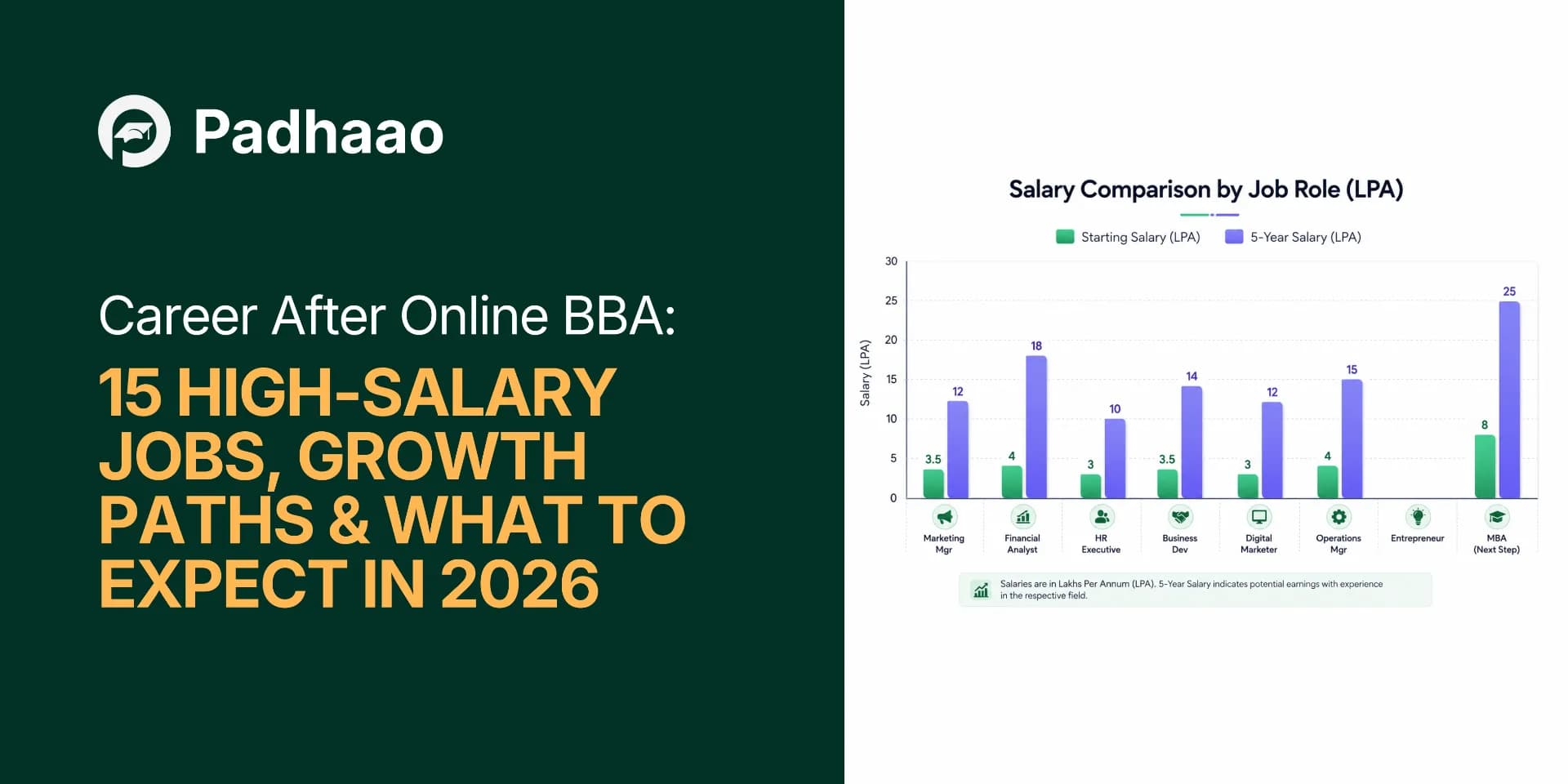
Career After Online BBA: 15 High-Salary Jobs, Growth Paths & What to Expect in 2026

CU Online BBA – Build Your Business Skills with 25 Specializations