How to Compare Online and Distance Education Programs in India Effectively
Compare Online and Distance Education programs in India—understand UGC-DEB approval, degree equivalence, fees, and key differences to choose the best.

The decision between online vs distance education India hinges primarily on how you wish to learn and interact with your curriculum: Online Education (OL) features a high degree of digital interaction, often including live (synchronous) classes and real-time assessments, while Distance Education (ODL - Open and Distance Learning) leans more on self-study materials, recorded content, and pre-scheduled examinations, offering maximum flexibility. For better career growth, students must compare universities online based on their UGC-DEB approval status, learning methodology, and the career support provided, ensuring they select from the best online programs in India that directly align with their professional goals.
Understanding the Core Distinction: Online (OL) vs. Distance (ODL)
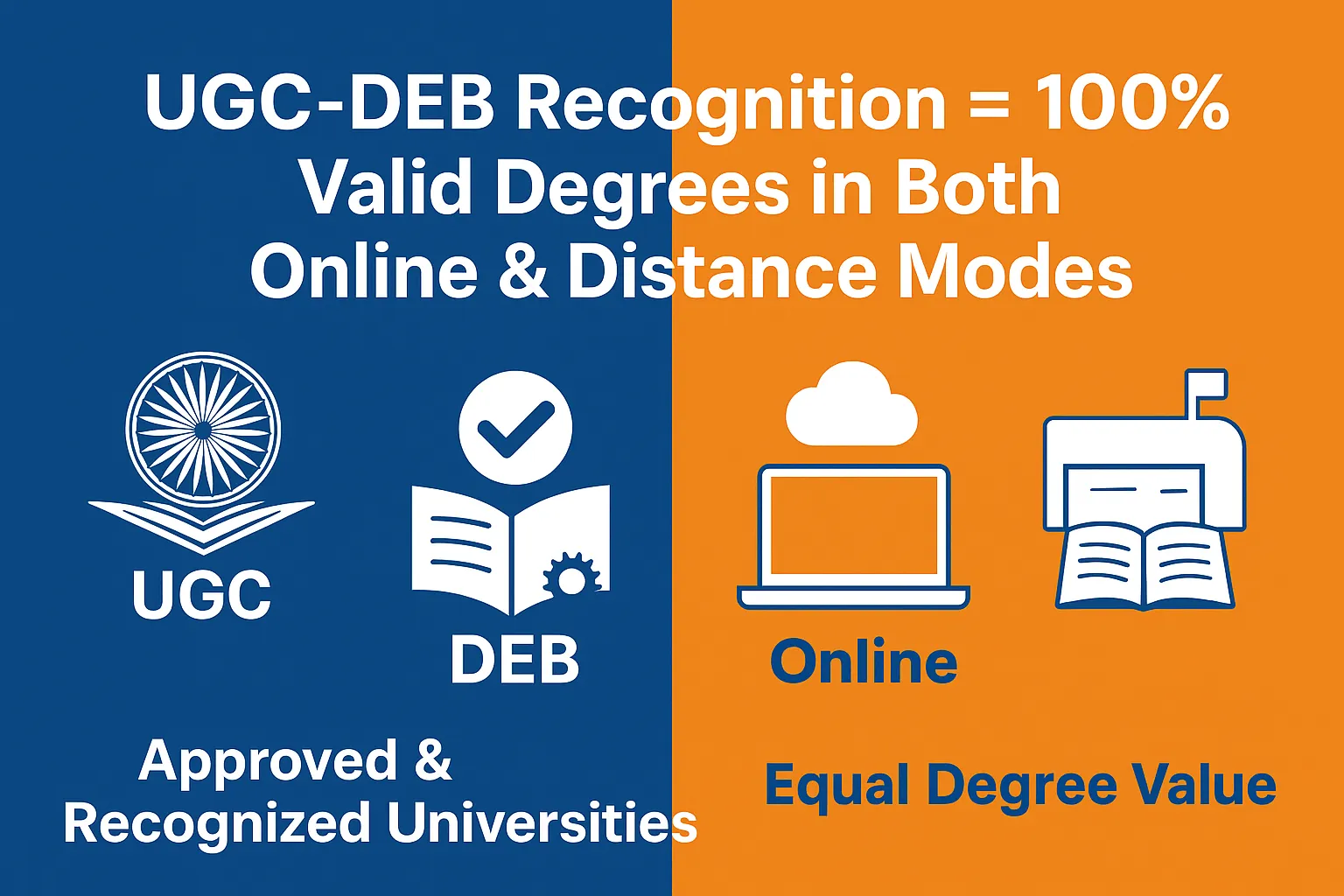
The terms "online" and "distance" are used interchangeably by most Indian students — but they are legally distinct categories under UGC rules, and the difference affects your degree's acceptance for jobs, government exams and international recognition.
Online Learning (OL): Regulated under UGC's Online Education Regulations 2020. Delivered through a Learning Management System (LMS). Live interactive sessions with faculty. Exams can be online-proctored. Universities need NAAC grade A or above to offer OL programmes.
Distance Education (DE): Regulated under DEB (Distance Education Bureau). Self-paced study with physical/digital study material. Exams at designated exam centres. Wider university eligibility — even B and B+ NAAC rated universities can offer DE programmes.
Both are fully recognised by AICTE (for management programmes), UGC and all government bodies including UPSC. The choice between them comes down to your learning style, internet access and programme availability.
Why This Choice Matters Now

The Indian education sector has undergone a massive transformation, especially after the COVID-19 pandemic. This is why the choice between the two modes is more crucial than ever before.
1. The Growth Surge: A Data-Centric Overview
The demand for flexible learning options has skyrocketed.
- Market Growth: As of 2022, the online education market in India was valued at approximately INR 361.68 billion. It is projected to continue its massive expansion, reaching an estimated INR 837.11 billion by 2028, growing at a CAGR of over 13.68%. This data highlights the massive confidence and investment pouring into the sector.
- Accessibility: The move to online learning allows people from remote or underserved areas to pursue higher education without having to relocate. Post-pandemic studies show that a large percentage of students now prefer a "blended mode" of learning (combining online and offline elements) or full online delivery, showcasing a permanent shift in preference.
2. Flexibility for the Modern Indian Professional
The single biggest driver for students to pursue online vs distance education in India is flexibility. According to industry reports, a significant percentage of future college students consider the balance between studying and committing to work or personal activities as their key deciding factor.
- Working Professionals: Online and Distance modes allow professionals to upskill with programs like the Executive Master of Business Administration or Online Master of Computer Applications without quitting their current job. This saves them from career breaks and income loss, making the Return on Investment (ROI) immediate and high.
- Career Switchers: Programs like the Online BCA or Online B.Sc. offer a pathway for students to gain relevant technical skills for the booming IT and Data Science sectors, which are seeing robust growth across India.
Unsure If Your Distance Degree Will Be Valid?
Our counsellors verify UGC-DEB approval status and guide you to safe, recognised distance programmes — free.
Five Key Factors to Compare Programs Effectively
Selecting the right program requires a systematic approach. You shouldn't just look at the course name; you must compare universities online using a detailed checklist focused on quality, delivery, and career outcome.
Factor 1: Accreditation and Recognition (The UGC-DEB Check)
Before you enroll, always verify the university’s status.
- Check the UGC-DEB Website: The first step is to visit the official UGC-DEB portal. They publish a list of Entitled and Recognized Higher Educational Institutions (HEIs) and the exact programs they are permitted to offer in the Online (OL) and ODL modes for the current academic session (e.g., 2024-25).
- Program-Specific Approval: Do not assume that if a university is approved, all its programs are approved. A university might have approval for the Online MBA but not the Online M.Sc. Always check the specific program.
- No Franchise Rule: Remember the strict UGC rule: HEIs must not offer programs under any franchise arrangement. The university must maintain full ownership and accountability for the program.
Factor 2: Learning Structure: Synchronous vs. Asynchronous
This factor determines your day-to-day learning experience.
- Synchronous (Live): This is common in pure Online Education (OL). You will have fixed class times where you must log in and interact with the faculty and peers. This is great for motivated learners who thrive on immediate interaction, but it demands a predictable schedule.
- Asynchronous (Pre-recorded): This is the hallmark of Distance Education (ODL). You get pre-recorded lectures, e-content, and Self-Instructional Material (SIM). It offers maximum flexibility but requires strong self-discipline.
- Your Personal Need: If you are a professional in a time-sensitive role, pure ODL might be better. If you are comfortable with structured online classes and want a feel closer to a traditional classroom, an OL program, such as the Online Master of Commerce or Online Bachelor of Business Administration, is the right fit.
Factor 3: Technology, Platform, and Support
The quality of the Learning Management System (LMS) can make or break an online education experience.
- User-Friendly LMS: Does the platform offer easy access to e-books, video lectures, and assignment submission portals? A well-designed LMS, like the ones used by Padhaao’s partner universities, ensures that students pursuing a technical course like the Online BCA + MCA or a specialized course like the Online MA in Journalism and Mass Communication have a smooth experience.
- Digital Divide Reality: While the online market is booming, technical challenges remain a reality in India (e.g., internet speed and device availability). Look for a program that offers both online lectures and downloadable content to prepare for connectivity issues.
Factor 4: Cost, Fee Structure, and Return on Investment (ROI)
One of the greatest advantages of pursuing distance or online education is the cost saving compared to a full-time, on-campus degree.
- Affordability: The fees for these programs are typically much lower than their regular counterparts. However, remember to factor in other costs.
- ROI Analysis: Consider your expected career outcome. A specialized program like the Online Global Master of Business Administration might have a slightly higher fee than a general one, but if it opens doors to a high-paying role like Business Development Manager (where salaries can range significantly higher), the ROI is excellent. Similarly, an Online Post Graduate Diploma in Management (PGDM) offers a quick, focused way to upskill for a management role.
- Financial Aid: Always check if the university offers scholarships or easy payment plans for online students.
Factor 5: Career and Placement Support
A degree alone is not enough; the support system is vital for getting ranked amongst the best online programs India.
- Mentorship and Workshops: Does the university offer career counseling, resume-building workshops, and mock interviews? These are critical services.
- Placement Assistance: Many UGC-DEB approved universities have dedicated placement cells for their online and distance students. They help connect students with prospective employers. Whether you are aiming for a Financial Analyst role after an Online B.Com or a Software Developer position after an Online MCA, placement support significantly improves your job prospects.
Your Educational Path with Padhaao: The Right Programs for the Right Future
Padhaao helps you filter and compare online and distance programmes based on your specific situation — your NAAC preference, exam mode, fee budget and career goal. Our comparison tool covers 200+ university-programme combinations.
The counselling process takes 15 minutes. We check UGC-DEB approval, NIRF ranking (if applicable), placement statistics and student reviews before recommending any programme. Free, no sales pressure.
Making the Final Decision and Ensuring Quality
Your choice between online and distance education is deeply personal, but it should always be backed by objective data and strict quality checks. Here is a simple, actionable checklist to help you move forward and secure your future through the best online programs in India:
The 3-Step Decision Checklist
- Verify UGC-DEB Approval: Confirm that the university and the specific program (e.g., Online MCA or Online MA) are listed on the official UGC-DEB website for the current academic session. Never enroll in an unapproved program.
- Assess Your Schedule and Personality:
- Need Live Classes & Structure? Choose Online (OL) programs.
- Need Maximum Flexibility & Self-Paced Learning? Choose Distance (ODL) programs.
- Evaluate the Placement Ecosystem: Look at the university’s track record for placement assistance and career services for their online/distance students. A quality program should not just award a degree but actively help you secure a better job.
Top Online Universities to Consider
All universities below are UGC-DEB approved and consistently offer flexible online programmes suited to working professionals and fresh graduates.
| University | NAAC | Popular Programmes | Annual Fees (approx) | Mode |
|---|---|---|---|---|
| Manipal University Online | A++ | BBA, MBA, MCA | ₹1.3–2.0L | Online |
| LPU Online | A++ | MBA, BCA, B.Sc | ₹0.9–1.8L | Online |
| Chandigarh University Online | A++ | MBA, BBA, B.Com | ₹1.0–1.6L | Online |
| IGNOU | A | BA, B.Com, MBA | ₹0.1–0.5L | Distance |
| Amity Online | A+ | MBA, BBA, MCA | ₹1.5–2.5L | Online |
| Sikkim Manipal University | B++ | MBA, MCA, BBA | ₹0.8–1.4L | Distance/Online |
| NMIMS Global Access | A | MBA, BBA, B.Com | ₹1.0–2.0L | Distance |
Unsure If Your Distance Degree Will Be Valid?
Our counsellors verify UGC-DEB approval status and guide you to safe, recognised distance programmes — free.
Conclusion
In conclusion, the decision of online vs distance education India is no longer about degree validity, but about choosing the right fit for your personal learning style and professional stage. By focusing on UGC-DEB accredited universities and the specific, high-quality course offerings like those available through Padhaao from foundational UG degrees like the Online BBA to strategic PG programs like the Online MBA, you can confidently pursue an education that is recognized, flexible, and career-accelerating.
Ready to start your journey? Don't let the confusion between online and distance modes hold you back. Let our expert counselors help you compare universities online and find the perfect UGC-DEB-approved program that fits your career goals and lifestyle. Start Your Journey to a Better Degree Now!
Explore Online Degree Options
| University | NAAC | Programmes |
|---|---|---|
| Manipal Online | A++ | MBA, BBA, BCA, MCA, BA, B.Com |
| LPU Online | A++ | MBA, BBA, BCA, MCA, BA, B.Com |
| Amity Online | A++ | MBA, BBA, BCA, MCA, BA, B.Com |
Best MBA Colleges | Top BBA Colleges | Top BCA Colleges | Is Online Degree Valid?
Frequently Asked Questions
Is an Online Degree (OL) from a UGC-approved university equal to a regular degree in India?
Yes, a degree obtained through the Online (OL) or Open and Distance Learning (ODL) mode from a UGC-DEB approved university is considered fully equivalent to a degree obtained through the conventional, full-time mode. This equivalence is mandated by the University Grants Commission (UGC) for employment and further education.
What is the main difference between Online Education (OL) and Distance Education (ODL)?
Online Education (OL) is highly technology-driven, often involves live (synchronous) classes, and has entirely online proctored exams, while Distance Education (ODL) relies more on self-study materials (asynchronous) and may require appearing for exams at physical Learner Support Centres (LSCs).
How can I verify if an online program offered by a university is legitimate?
You must check the official UGC-DEB (Distance Education Bureau) website, which publishes a definitive, session-wise list of all Entitled and Recognized universities and the specific programs they are allowed to offer in the online or distance mode.
Do I need a high-speed internet connection for distance education programs?
While Distance Education (ODL) traditionally relies on printed material, you will still need a moderate internet connection to access digital study materials, submit assignments, and appear for any online components or exams.
Which mode is better for a working professional: Online (OL) or Distance (ODL)?
The ODL mode offers maximum flexibility due to its highly self-paced structure, making it ideal for those with unpredictable or demanding work schedules, whereas the OL mode is better for professionals who prefer structured live classes.
Unsure If Your Distance Degree Will Be Valid?
Our counsellors verify UGC-DEB approval status and guide you to safe, recognised distance programmes — free.
Recommended Articles
Amity University Online: How to Navigate the Learning Platform

Top 10 Online BA Courses in India: UGC-Approved Degrees 2026

Top 10 Distance Learning MBA Colleges in India for 2026

CU Online BBA – Build Your Business Skills with 25 Specializations

UGC Approved Distance Education Universities in India 2026: Complete List