BCA with Cyber Security Specialization 2026 — Colleges, Fees, Salary & Career
BCA with Cyber Security: top colleges, course details, fees, career scope & starting salary in India 2026. Honest guide — no JEE needed, 3 years, ₹3–8 LPA starting.
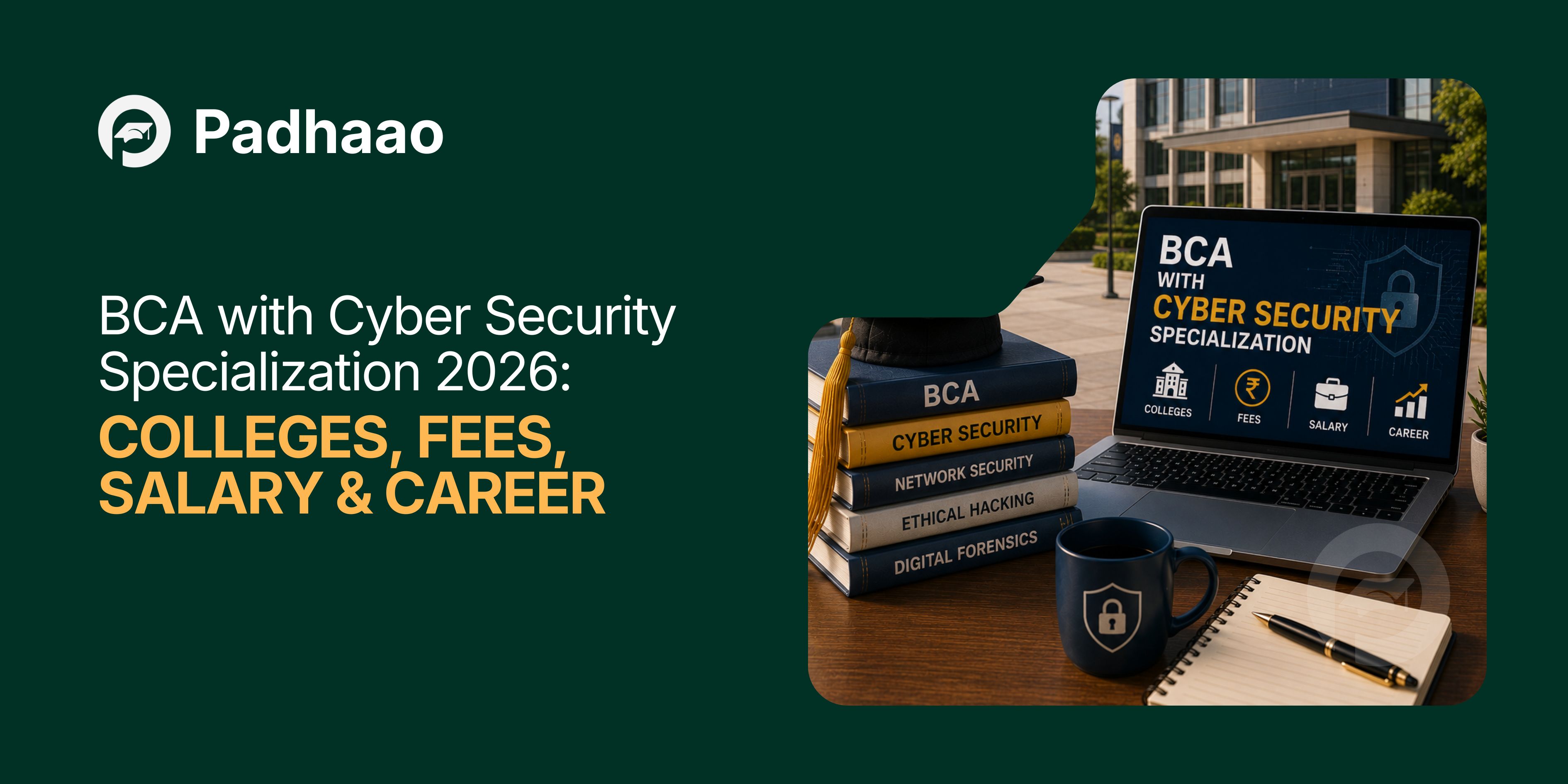
BCA with Cyber Security is one of the more practical undergraduate courses you can pick right now — and most students don't even know it exists. While everyone fights over B.Tech CSE seats and JEE ranks, BCA Cyber Security quietly offers the same career doors in ethical hacking, network security, and SOC analysis — without needing JEE, and at roughly half the fees.
This is a 3-year degree (same as regular BCA) where the specialization replaces electives with subjects like ethical hacking, cryptography, network security, and digital forensics. You finish with a BCA degree plus a specialization credential. For IT security roles at product companies, startups, and consulting firms, recruiters care far more about your certifications and practical skills than whether your degree says B.Tech or BCA.
This guide covers every college offering this in India, what you actually study, what jobs you can get, and whether the course is worth it compared to B.Tech Cyber Security.
What is BCA with Cyber Security — and How is It Different from Regular BCA?

Regular BCA covers programming, databases, networking, and software development — general IT education. BCA with Cyber Security keeps all of that but replaces the open electives in years 2 and 3 with a focused curriculum on information security. You are still doing the same core programming in year 1, but by year 3 you are doing ethical hacking labs, penetration testing exercises, and digital forensics.
The honest difference from B.Tech Cyber Security: B.Tech goes deeper into computer architecture, mathematics, and systems-level programming. BCA is more applied and practical. For roles like Security Analyst, SOC Analyst, Ethical Hacker at a mid-size company, both degrees land you in the same pool. Where B.Tech genuinely wins is at product companies like Microsoft, Google, or Cisco for security engineering roles — those typically prefer B.Tech or want you to have cleared a competitive entrance exam.
| Factor | BCA Cyber Security | B.Tech Cyber Security |
|---|---|---|
| Duration | 3 years | 4 years |
| Entrance Required | No JEE — 12th marks or college entrance | JEE Main / state CET |
| Total Fees (private) | ₹2–5 lakh (total) | ₹6–16 lakh (total) |
| Starting Salary | ₹3–6 LPA | ₹4–8 LPA |
| Best For | Students who missed JEE, want faster entry into IT security | Students who want deep systems + security engineering |
| Higher Study Options | MCA, M.Sc Cyber Security, CEH/CISSP certifications | M.Tech, MS abroad, MBA |
If you scored below 70% in 12th and didn't clear JEE but want a career in IT security, BCA Cyber Security is the most direct path available. Stop comparing it to B.Tech and start comparing it to being stuck in a college you don't want.
Top Colleges Offering BCA with Cyber Security in India 2026
Not every college that says "BCA" offers a dedicated Cyber Security specialization — many just bundle one or two security electives and call it a specialization. The colleges below have a proper curriculum with dedicated Cyber Security tracks.
| College | Location | Annual Fees (approx) | Specialization Name | NAAC |
|---|---|---|---|---|
| Lovely Professional University (LPU) | Phagwara, Punjab | ₹1.10–1.30 lakh/yr | BCA – Cyber Security | A+ |
| Chandigarh University | Mohali, Punjab | ₹1.20–1.40 lakh/yr | BCA – Cyber Security & Forensics | A++ |
| Amity University | Noida / Multiple | ₹1.50–1.80 lakh/yr | BCA – Cyber Security | A+ |
| UPES Dehradun | Dehradun | ₹1.80–2.10 lakh/yr | BCA – Cyber Security | A |
| Sharda University | Greater Noida | ₹90K–1.10 lakh/yr | BCA – Information Security | A+ |
| SRM Institute | Chennai / Delhi NCR | ₹1.20–1.50 lakh/yr | BCA – Cyber Security | A++ |
| Manipal University Jaipur | Jaipur | ₹1.40–1.60 lakh/yr | BCA – Cyber Security | A |
| Chitkara University | Punjab | ₹1.00–1.20 lakh/yr | BCA – Cyber Security | A+ |
| Graphic Era University | Dehradun | ₹85K–1.00 lakh/yr | BCA – Cyber Security | A |
| Bennett University | Greater Noida | ₹2.00–2.40 lakh/yr | BCA – Cyber Security | A+ |
LPU and Chandigarh University offer the best value — NAAC A+/A++ rating with fees under ₹1.40 lakh per year. Both have dedicated security labs and industry tie-ups with companies like IBM and EC-Council (the body that gives the CEH certification).
Ready to Start?
BCA Cyber Security Syllabus — What You Actually Study
The syllabus varies slightly by university but here is what a standard 3-year BCA Cyber Security programme covers:
| Year | Core Subjects | Cyber Security Subjects |
|---|---|---|
| Year 1 | Programming in C/Python, Mathematics for Computing, Database Management, Computer Organization | Introduction to Cyber Security, Basics of Networking & Protocols |
| Year 2 | Data Structures, Web Technologies, Operating Systems, Software Engineering | Ethical Hacking Fundamentals, Cryptography & Network Security, Linux Security |
| Year 3 | Cloud Computing, Project Work, Internship | Penetration Testing, Digital Forensics, Malware Analysis, Cyber Law & Compliance |
Practical labs are a major component — you spend time in dedicated cyber security labs doing live penetration testing on sandboxed environments. Some universities use platforms like TryHackMe, HackTheBox, or Cisco Packet Tracer for lab work.
Many programmes also include preparation modules for certifications like CompTIA Security+, CEH (Certified Ethical Hacker), and CCNA Security. These are not mandatory but completing one during your BCA significantly improves placement chances.
Eligibility — Who Can Apply for BCA Cyber Security?
The eligibility is the same as regular BCA. There is no separate entrance exam in most colleges — your 12th marks are the primary criterion.
- Minimum qualification: 10+2 from any recognized board
- Stream: Most colleges accept all streams — Science, Commerce, Arts. You do not need Physics/Math in 12th (unlike B.Tech).
- Minimum marks: 45–60% aggregate in 12th (varies by college). LPU and CU take students from 45%. Amity and UPES typically require 60%.
- Entrance exam: Some colleges have their own entrance (LPUNEST, CUET, Amity JEE) — these are easy and not competitive. Most students qualify without preparation.
- Age limit: No upper age limit for BCA at most private universities.
Step-by-Step
Admission Process — Course Guide (2026)
Check Eligibility
Typically requires a Bachelor's degree (any stream) with min. 50% marks. Work experience is a plus for executive programs.
Fill Application Form
Submit the online form with personal details, academic records, and work experience. Most universities accept applications year-round.
Upload Documents
Mark sheets, degree certificate, ID proof, passport photo, and work experience letter (if applicable).
Pay Fees & Confirm Seat
Pay the initial semester/year fees online to confirm your seat. Many universities offer EMI options.
Career Scope After BCA Cyber Security — Jobs & Salary in 2026
The cyber security job market in India is growing fast. There is a genuine shortage of skilled professionals — which means even fresh BCA Cyber Security graduates are finding jobs that previously required B.Tech or certifications.
| Job Role | Starting Salary (freshers) | 5 Years Exp | Who Hires |
|---|---|---|---|
| SOC Analyst (L1/L2) | ₹3–5 LPA | ₹8–14 LPA | TCS, Wipro, Infosys, HCL, IBM |
| Ethical Hacker / Pen Tester | ₹4–6 LPA | ₹12–22 LPA | Quick Heal, Rediff, Security startups |
| Cyber Security Analyst | ₹3.5–5.5 LPA | ₹9–16 LPA | IT services, BFSIs, consulting firms |
| Network Security Engineer | ₹4–6 LPA | ₹12–20 LPA | Cisco partners, ISPs, enterprise IT |
| Digital Forensics Analyst | ₹3–5 LPA | ₹8–14 LPA | Govt agencies, legal firms, corporates |
| Vulnerability Analyst | ₹4–7 LPA | ₹14–25 LPA | CERT-In empanelled firms, banks |
The honest starting point for most BCA Cyber Security graduates is ₹3.5–5 LPA — this is at NASSCOM-member IT companies. If you have a CEH or CompTIA Security+ certification alongside your degree, that floor jumps to ₹5–7 LPA and you're competing directly with B.Tech graduates for the same roles.
After 3–5 years with solid experience and one or two advanced certifications (CISSP, OSCP), cyber security professionals routinely reach ₹18–30 LPA. The ceiling is genuinely high — cloud security and red team specialists are among the highest-paid IT professionals in India right now.
Career Outcomes
Career & Placement Overview — Course Guide Graduates
Average Package
₹5 – 12 LPA
Post-graduation median salary
Highest Package
₹20 – 40 LPA
Top offers from premium recruiters
Salary Hike
25 – 60%
Reported within 2 yrs of graduation
Hiring Partners
300+
Across industries & cities
Ready to Start?
Online BCA with Cyber Security — Is That an Option?
Yes, a few UGC-DEB approved universities offer online BCA with a Cyber Security specialization or concentration. This is worth considering if you are working or can't relocate.
| University | Online BCA + Cyber Sec? | Annual Fees | UGC-DEB Approved |
|---|---|---|---|
| Chandigarh University Online | Yes — BCA Cyber Security | ₹35–45K/yr | Yes |
| LPU Online | Yes — BCA with specialization options | ₹30–40K/yr | Yes |
| Manipal Online (MAHE) | BCA — limited Cyber Sec electives | ₹40–55K/yr | Yes |
| Amity Online | BCA — elective in Cyber Security | ₹45–60K/yr | Yes |
The degree validity is the same as regular BCA for most government jobs and private sector hiring. The disadvantage of online is the lab experience — penetration testing and hands-on security labs are difficult to replicate remotely. If you are going online, supplement with platforms like TryHackMe, HackTheBox, or bug bounty programmes to build real skills alongside the degree.
BCA Cyber Security vs MCA Cyber Security — Which is Better?
If you have already done BCA and are wondering whether to do MCA with Cyber Security next — here is the honest comparison:
| BCA Cyber Security | MCA Cyber Security (after BCA) | |
|---|---|---|
| Level | Undergraduate (UG) | Postgraduate (PG) |
| Duration | 3 years | 2 years |
| Starting salary | ₹3.5–6 LPA | ₹5–9 LPA |
| Job level | Junior/entry roles | Mid-level, specialist roles |
| Best path | Fresher entering IT security | Career upgrade, senior analyst, team lead roles |
Doing BCA → MCA Cyber Security is a strong 5-year path that ends at roughly the same career stage as a B.Tech graduate — and at significantly lower total cost. Many students at LPU and CU follow this exact path.
Should You Choose BCA Cyber Security? Honest Verdict
BCA Cyber Security makes sense if:
- You missed JEE or didn't get into a good B.Tech college
- You are interested in IT security but don't want to commit to 4 years of engineering
- Your family budget is under ₹6 lakh total for the degree
- You are willing to do certifications (CEH, CompTIA Security+) alongside the degree
It does not make sense if:
- You have a JEE rank good enough for a decent NIT or private engineering college — in that case, B.Tech CSE or B.Tech Cyber Security will give you more options, especially for product companies
- You want to go abroad for MS — B.Tech is preferred by US/UK universities for CS master's programmes
The bottom line: BCA Cyber Security is a practical, affordable path into one of India's fastest-growing career fields. It is not a consolation prize — it is a deliberate choice that makes financial and career sense for a specific type of student. If that's you, pick it with confidence and invest seriously in your certifications.
Conclusion
BCA with Cyber Security is one of those rare combinations where you get an in-demand technical skill without the JEE pressure. If you're comfortable with basic maths and interested in how digital systems work (and fail), this is a solid 3-year investment. The key is picking a college that actually runs the specialisation properly — check the lab infrastructure and placement record before you pay the fees.
Frequently Asked Questions
Can I get a cyber security job with a BCA degree?
What is the salary after BCA Cyber Security in India?
Is JEE required for BCA Cyber Security?
Which is better — BCA Cyber Security or B.Tech Cyber Security?
What certifications should I do alongside BCA Cyber Security?
Take the Next Step
Recommended Articles

Top Online BCA Colleges in India 2026: Fees, Placements & Career Guide

Online BBA vs BCA: Which Course is Better for Your Career in 2026?

VGU Online vs CU Online — Which Is Better for Online BCA?

Online B.Tech Degree 2026: Valid or Not? Fees, Top Programmes & Honest Comparison
B.Tech (Bachelor of Technology): Branches, Eligibility, Fees, Top Colleges & Career Scope 2026