B.Com Course Details 2026: Full Form, Subjects, Fees, Career Options & Scope
B.Com (Bachelor of Commerce) course guide 2026: full form, subjects, B.Com Honours vs General, fees, top colleges, career options (CA, CS, MBA, Banking) & salary after B.Com.

B.Com (Bachelor of Commerce) is India’s most enrolled undergraduate degree — and for good reason. It’s the gateway to CA, CS, CMA, banking, MBA, and virtually every finance and accounting career. Over 40 lakh students pursue B.Com every year across India.
But here’s the problem: a plain B.Com without any professional course alongside has very limited job prospects. The students who succeed after B.Com are those who pair it with CA, CS, CMA, or skill certifications from Day 1. This guide covers everything — subjects, fees, B.Com Honours vs General, and most importantly, what to do during B.Com to maximise your career outcomes.
B.Com Full Form & Course Overview
B.Com stands for Bachelor of Commerce. It’s a 3-year undergraduate degree (6 semesters) focused on commerce, accounting, economics, taxation, and business studies.
| Parameter | B.Com (General) | B.Com (Honours) |
|---|---|---|
| Duration | 3 years | 3 years |
| Eligibility | 12th pass (any stream, 45%+) | 12th Commerce (50%+, varies by college) |
| Depth of Study | Broad overview of commerce subjects | Deep specialisation in one area (Accounting, Tax, etc.) |
| Difficulty | Easier | Harder (more analytical) |
| Best For | Students who want flexibility | Students targeting CA/CS/CMA or academic excellence |
| Avg Fees (Govt) | ₹5K–20K/year | ₹10K–30K/year |
| Job Prospects (standalone) | Limited | Slightly better (honours is preferred) |
| Top Colleges | Available everywhere | SRCC, Hindu, Christ, St. Xavier’s, Loyola |
B.Com Honours vs General — which one? Always choose Honours if available. It’s more respected by employers, better preparation for CA/MBA entrance, and most top colleges only offer Honours. General B.Com is fine if you’re doing it alongside CA/CS coaching and just need the degree.
B.Com Subjects — What You’ll Study

| Semester | Core Subjects | Electives (vary by university) |
|---|---|---|
| Sem 1-2 | Financial Accounting, Business Economics, Business Law, Business Communication | Computer Applications, Environmental Studies |
| Sem 3-4 | Corporate Accounting, Cost Accounting, Income Tax, Business Statistics | E-Commerce, Entrepreneurship, Banking |
| Sem 5-6 | Auditing, Management Accounting, GST & Indirect Tax, Financial Management | International Business, Stock Market, Insurance |
Subjects that matter most for career:
- For CA: Financial Accounting, Cost Accounting, Auditing, Income Tax — these directly overlap with CA Foundation and Inter syllabus. B.Com Honours students often find CA 30–40% easier because they’ve already studied these topics.
- For Banking exams: Business Economics, Business Statistics, Financial Management — build your quantitative aptitude foundation.
- For MBA: All subjects help broadly, but Business Economics and Financial Management are most relevant for CAT/MAT preparation.
The biggest advantage of B.Com is the overlap with professional courses. If you’re doing CA alongside B.Com, you’re essentially studying the same topics twice — once in college, once in CA coaching. This reinforcement makes both easier.
Top B.Com Colleges in India 2026
| Rank | College | Location | Programme | Annual Fees | Admission | Known For |
|---|---|---|---|---|---|---|
| 1 | SRCC (Shri Ram College of Commerce) | Delhi | B.Com (H) | ₹25K | CUET UG | Best placement, CA pass rate |
| 2 | Hindu College | Delhi | B.Com (H) | ₹20K | CUET UG | Strong academics, alumni network |
| 3 | St. Xavier’s College | Mumbai/Kolkata | B.Com | ₹15K–30K | Merit + entrance | Best in Maharashtra/WB |
| 4 | Christ University | Bangalore | B.Com, BBA | ₹80K | Christ entrance | South India’s best commerce college |
| 5 | Loyola College | Chennai | B.Com | ₹10K | Merit | Strong CA coaching culture |
| 6 | Hansraj College | Delhi | B.Com (H) | ₹20K | CUET UG | Top DU commerce college |
| 7 | KJ Somaiya | Mumbai | B.Com | ₹30K | Merit + entrance | Strong industry connections |
| 8 | Narsee Monjee | Mumbai | B.Com (H) | ₹50K | Merit | Finance and banking placements |
| 9 | Presidency College | Chennai | B.Com | ₹5K | Merit | Cheapest top-quality option |
| 10 | St. Joseph’s College | Bangalore | B.Com | ₹40K | Merit + entrance | Strong placements in banking |
For commerce, government colleges genuinely offer better education than most private colleges. SRCC, Hindu, Hansraj (DU) and Loyola, Presidency (Chennai) produce more CAs and successful bankers than any expensive private college. Focus on getting into a top government college through CUET — the ROI is unbeatable.
Career Options After B.Com — The Complete Path Map
This is where it gets critical. B.Com alone has limited value — it’s what you pair with B.Com that determines your career:
| Career Path | What to Do | Timeline | Salary Potential | Difficulty |
|---|---|---|---|---|
| Chartered Accountant (CA) | CA Foundation (during 12th) → Inter → Articleship → Final | 4–5 years after 12th | ₹7–15 LPA (start), ₹30–80 LPA (5 yrs) | Very Hard (10–15% pass rate) |
| Company Secretary (CS) | CS Foundation → Executive → Professional | 3–4 years | ₹5–10 LPA (start), ₹15–30 LPA (5 yrs) | Hard (20–25% pass rate) |
| CMA (Cost & Management Accountant) | CMA Foundation → Inter → Final | 3–4 years | ₹5–8 LPA (start), ₹12–25 LPA (5 yrs) | Moderate-Hard |
| MBA (CAT/MAT/XAT) | Prepare for MBA entrance after B.Com | 2 years (MBA) | ₹8–20 LPA (top MBA), ₹4–8 LPA (avg MBA) | Moderate (exam) + fees |
| Banking (IBPS PO/SBI PO) | Prepare for banking exams during B.Com | 1–2 years prep | ₹5–8 LPA + benefits | Moderate |
| Government Jobs (SSC CGL) | SSC CGL, State PSC exams | 1–3 years prep | ₹5–8 LPA + benefits | Moderate-Hard |
| Digital Marketing | Google/HubSpot certifications during B.Com | 3–6 months | ₹3–6 LPA | Easy |
| Data Analytics | Learn Excel, SQL, Python, Tableau | 3–6 months | ₹4–8 LPA | Moderate |
| Stock Market / Financial Planning | NISM certifications, CFP | 6–12 months | ₹3–6 LPA + commissions | Moderate |
The golden rule for B.Com students: Start CA/CS/CMA Foundation in your 1st year of B.Com itself. Don’t wait until graduation. Students who clear CA Inter by the time they finish B.Com are 2 years ahead of those who start CA after graduation.
Career Outcomes
Career & Placement Overview — Education Graduates
Average Package
₹5 – 12 LPA
Post-graduation median salary
Highest Package
₹20 – 40 LPA
Top offers from premium recruiters
Salary Hike
25 – 60%
Reported within 2 yrs of graduation
Hiring Partners
300+
Across industries & cities
B.Com vs BBA — Which Is Better?
The most common confusion for commerce students after 12th:
| Factor | B.Com (Honours) | BBA |
|---|---|---|
| Focus | Accounting, taxation, finance | Management, marketing, operations |
| Best Pairing | CA, CS, CMA | MBA, digital marketing |
| Fees (Govt) | ₹5K–30K/year | ₹20K–50K/year |
| Fees (Private) | ₹50K–1L/year | ₹1–3L/year |
| Direct Job Prospects | Limited without CA/CS | Slightly better (management trainee roles) |
| Government Job Prep | Better (stronger quant and reasoning foundation) | Moderate |
| MBA Entrance Prep | Good (strong quant) | Good (management concepts) |
| CA Compatibility | Excellent (70%+ syllabus overlap) | Low (different focus areas) |
Bottom line: Choose B.Com if you’re planning CA/CS/CMA or banking exams. Choose BBA if you’re planning MBA or want to enter management/marketing directly. If you’re unsure, B.Com is the safer choice — it keeps more doors open and costs less.
B.Com Fees & Online B.Com Options
B.Com is one of the cheapest degrees in India, especially at government colleges:
| Mode | College Type | Annual Fees | Total (3 years) | Best For |
|---|---|---|---|---|
| Regular | Government (DU, state universities) | ₹5,000–30,000 | ₹15K–90K | Full-time students targeting CA/placements |
| Regular | Private (Christ, Xavier’s, etc.) | ₹50,000–1,50,000 | ₹1.5L–4.5L | Students wanting branded private college |
| Online | UGC-DEB approved universities | ₹10,000–40,000 | ₹30K–1.2L | Working students, CA aspirants who want flexibility |
| Distance | IGNOU, state open universities | ₹5,000–15,000 | ₹15K–45K | Students focused entirely on CA/CS prep |
For CA aspirants who want maximum time for CA coaching, an online or distance B.Com from a UGC-DEB approved university is a strategic choice. You get the degree (needed for CA Final eligibility) without spending 6 hours daily in college. IGNOU B.Com costs just ₹15,000 total — that’s probably the best education bargain in India.
Fee Comparison
Estimated Fee Structure — Education (2026)
2–4 Years
2–4 Years
2–4 Years
M.Com — Is It Worth Doing After B.Com?
M.Com (Master of Commerce) is a 2-year postgraduate degree. Here’s the honest assessment:
M.Com is worth it if:
- You want to become a commerce professor (M.Com + UGC NET is the path)
- You need a PG degree for government job eligibility (some posts require master’s)
- You’re doing it from a top university (DU, BHU) where it adds genuine value
M.Com is NOT worth it if:
- You’re doing it just because you don’t know what else to do — an MBA or professional course (CA/CS) is a better use of 2 years
- You expect significantly better job prospects — the salary difference between B.Com and M.Com in the private sector is minimal (₹2,000–5,000/month)
- You can do MBA instead — MBA opens many more career doors than M.Com
M.Com full form: Master of Commerce. Duration: 2 years. Eligibility: B.Com (50%+ marks typically). Fees: ₹5,000–20,000/year (govt), ₹30,000–1L/year (private).
Frequently Asked Questions
What is the full form of B.Com?
What are the subjects in B.Com?
What is the salary after B.Com?
Is B.Com Honours better than B.Com General?
Can I do CA after B.Com?
Recommended Articles
Online B.Com vs Regular B.Com: 10 Advantages & Disadvantages

NMIMS Online B.Com vs M.Com: Which Commerce Programme to Choose?
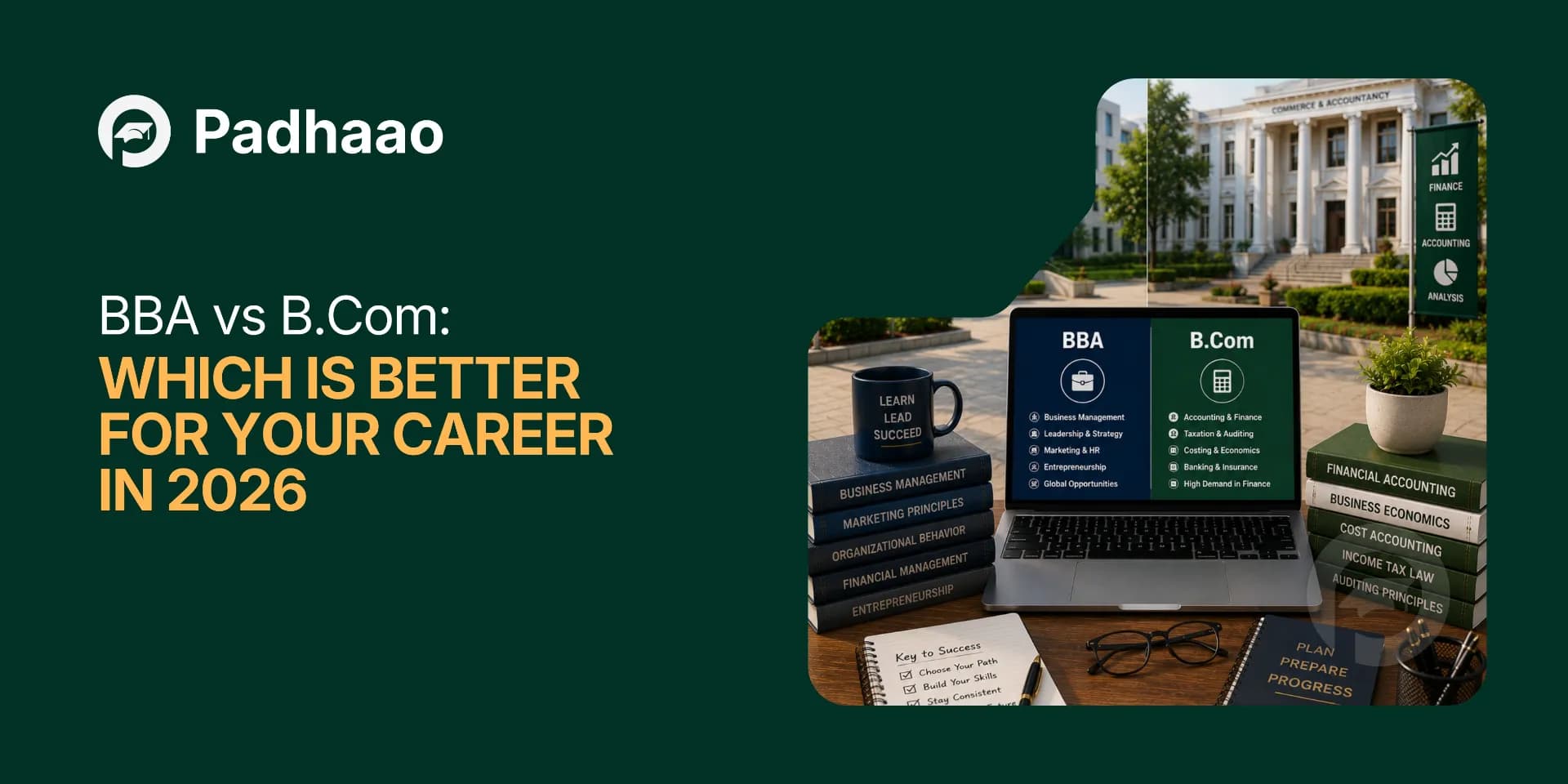
BBA vs B.Com — Which Is Better for Your Career in 2026?

Amity University B.Com Fees 2026 — All Campuses, Programs & Scholarship Guide

21 Practical Business Ideas for College Students in 2026 – Earn While Learning