CBSE Class 12 Physics Question Paper 2026: PDF Download, Analysis & Chapter Weightage
Download CBSE Class 12 Physics 2026 question paper PDF. Chapter-wise weightage, difficulty analysis, marking scheme, time management tips, and year-over-year comparison.
The CBSE Class 12 Physics Board Exam 2026 was conducted on 20 February 2026 (Paper Code: 042). If you're looking to download the question paper PDF, check the answer key, or understand how this year's paper compared to previous years — this is the most comprehensive resource you'll find.
Download CBSE Class 12 Physics 2026 — Official PDFs

| Document | Language | Download |
|---|---|---|
| Sample Question Paper | English | Download PDF |
| Marking Scheme | English | Download PDF |
| प्रश्न पत्र (Sample Paper) | Hindi | Download PDF |
| अंकन योजना (Marking Scheme) | Hindi | Download PDF |
Source: cbseacademic.nic.in — Official CBSE Academic Unit
Exam Quick Facts
| Detail | Value |
|---|---|
| Paper Code | 042 (Physics) |
| Exam Date | 20 February 2026 |
| Total Marks | 70 (Theory) + 30 (Practical) = 100 |
| Duration | 3 hours |
| Total Questions | 34 (with internal choices) |
| Sets | 55/5/1, 55/5/2, 55/5/3 |
CBSE Class 12 Physics 2026 — Exam Pattern
| Section | Question Type | No. of Questions | Marks Each | Total Marks |
|---|---|---|---|---|
| Section A | MCQs | 16 | 1 | 16 |
| Section B | Short Answer (SA-I) | 5 | 2 | 10 |
| Section C | Short Answer (SA-II) | 7 | 3 | 21 |
| Section D | Case Study | 3 | 4 | 12 |
| Section E | Long Answer | 3 | 5 | 15 |
Note: Internal choices are available in some questions. Total theory marks = 70 (not 74) because 2 MCQs in Section A are assertion-reason type.
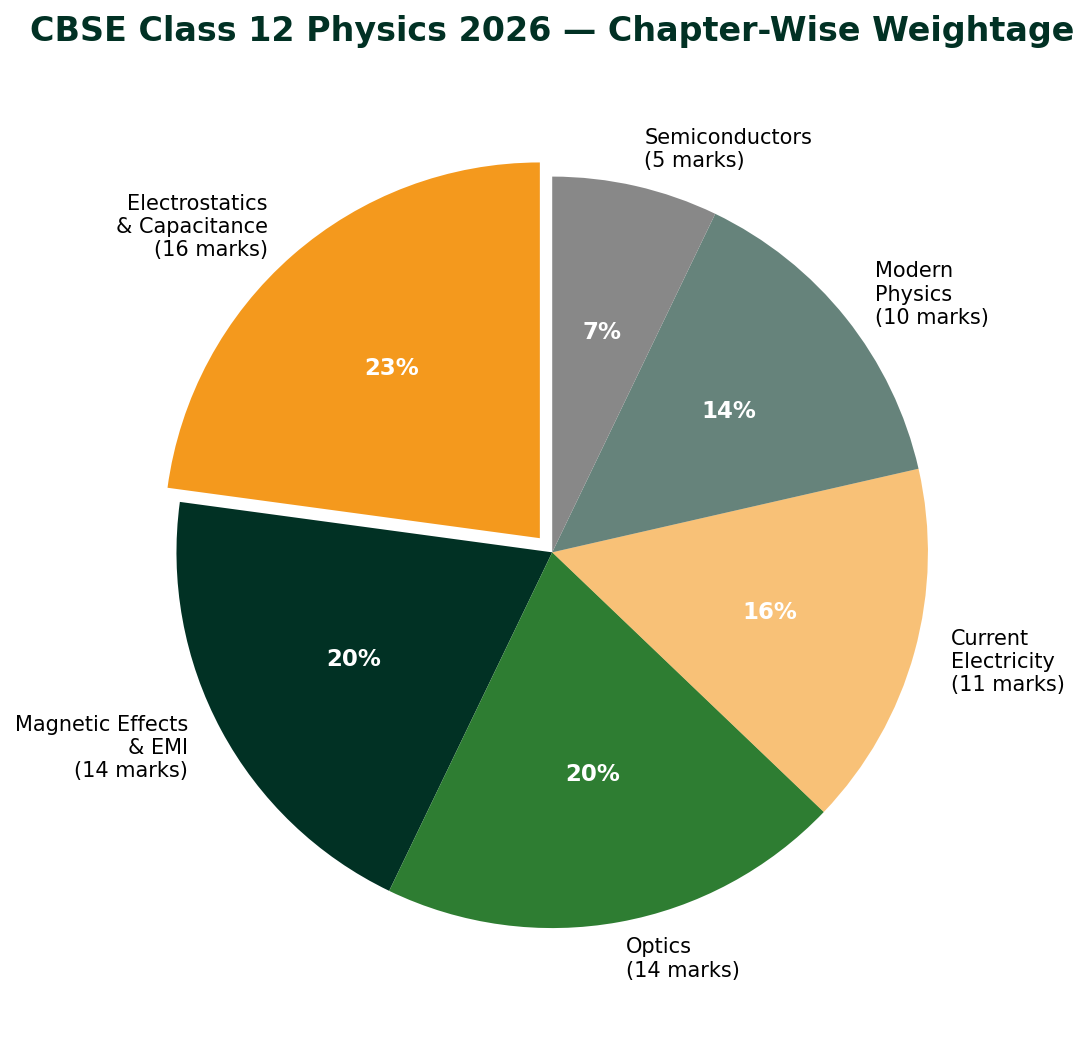 >
>Chapter-Wise Weightage — CBSE Physics 2026
This is what no other site gives you in detail. Based on analysis of the 2026 paper and CBSE's published blueprint:
| Unit/Chapter | Marks | % of Paper | Key Topics |
|---|---|---|---|
| Electrostatics & Capacitance | 16 | 23% | Coulomb's law, electric field, potential, capacitors |
| Current Electricity | 11 | 16% | Ohm's law, Kirchhoff's rules, Wheatstone bridge, meter bridge |
| Magnetic Effects & EMI | 14 | 20% | Biot-Savart, Ampere's law, Faraday's law, AC circuits |
| Optics (Ray + Wave) | 14 | 20% | Refraction, lenses, interference, diffraction, polarization |
| Modern Physics | 10 | 14% | Photoelectric effect, Bohr model, nuclear physics, radioactivity |
| Semiconductor Electronics | 5 | 7% | p-n junction, diodes, transistors, logic gates |
Confused about which course to pick?
Our counsellors have helped 10,000+ students choose the right program. Get a free 15-minute call — no pressure, no sales pitch.
2026 Paper Difficulty Analysis
Based on student feedback and expert review, the 2026 Physics paper was rated moderate overall — slightly easier than 2025 but tougher than 2024. Here's the section-wise breakdown:
- Section A (MCQs): Moderate. Most questions were NCERT-based, but 3-4 MCQs had tricky options that required careful reading. Assertion-reason questions were straightforward.
- Section B (2-mark): Easy to moderate. Direct theory and formula-based questions. Students who memorized derivations scored full marks here.
- Section C (3-mark): Moderate to difficult. Included numerical problems on Current Electricity and Optics that required multi-step calculations.
- Section D (Case Study): Moderate. Case studies were based on practical applications — electromagnetic induction, optical instruments, and semiconductor devices.
- Section E (5-mark): Difficult. Long derivations from Electrostatics and Optics. Students who practiced derivation-heavy questions had an advantage.
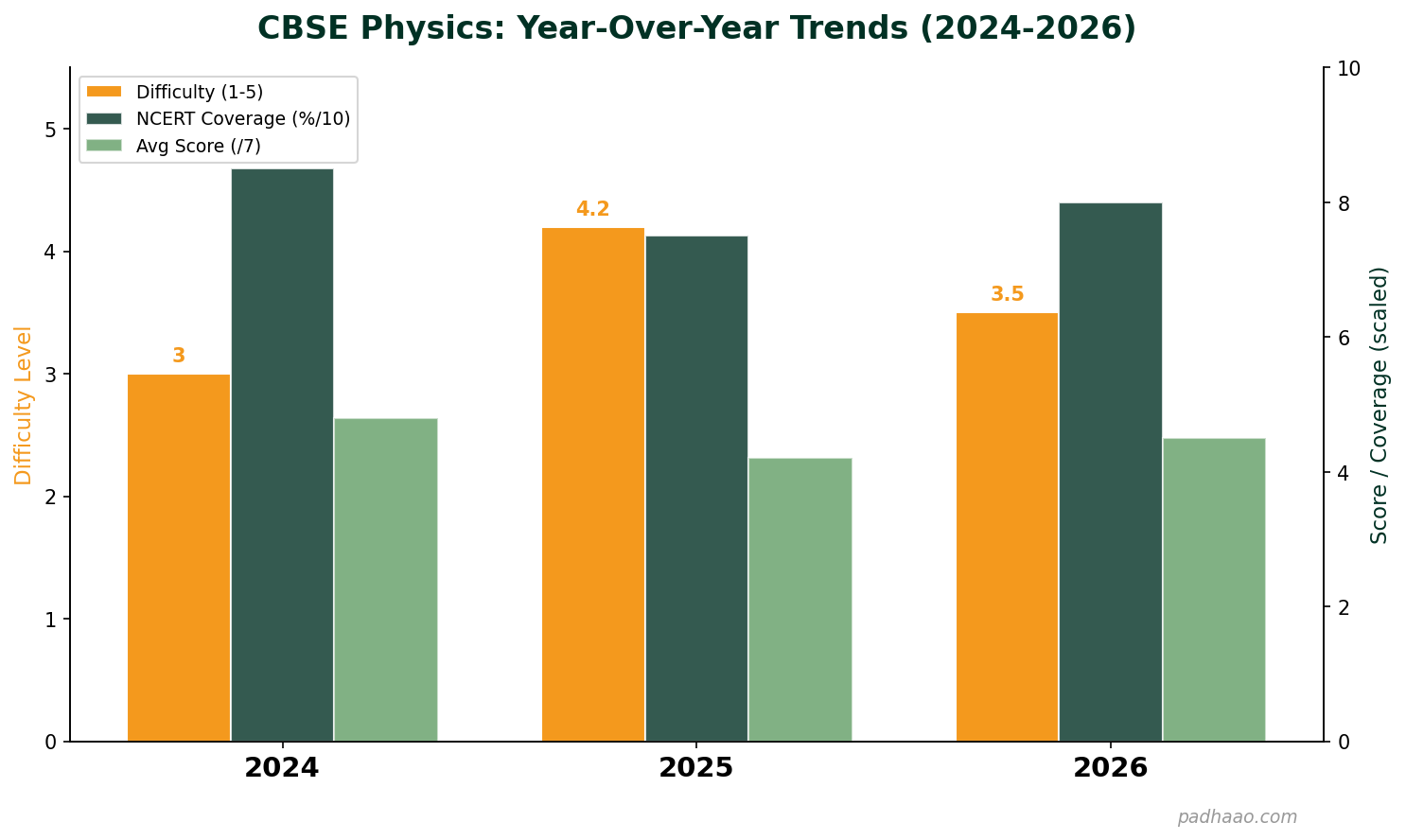 >
>Year-Over-Year Comparison: 2024 vs 2025 vs 2026
| Parameter | 2024 | 2025 | 2026 |
|---|---|---|---|
| Overall Difficulty | Easy-Moderate | Moderate-Difficult | Moderate |
| NCERT Coverage | 85% | 75% | 80% |
| Numerical Questions | 8 | 10 | 9 |
| Derivation-Based | 3 | 4 | 4 |
| Expected Avg Score | 48/70 | 42/70 | 45/70 |
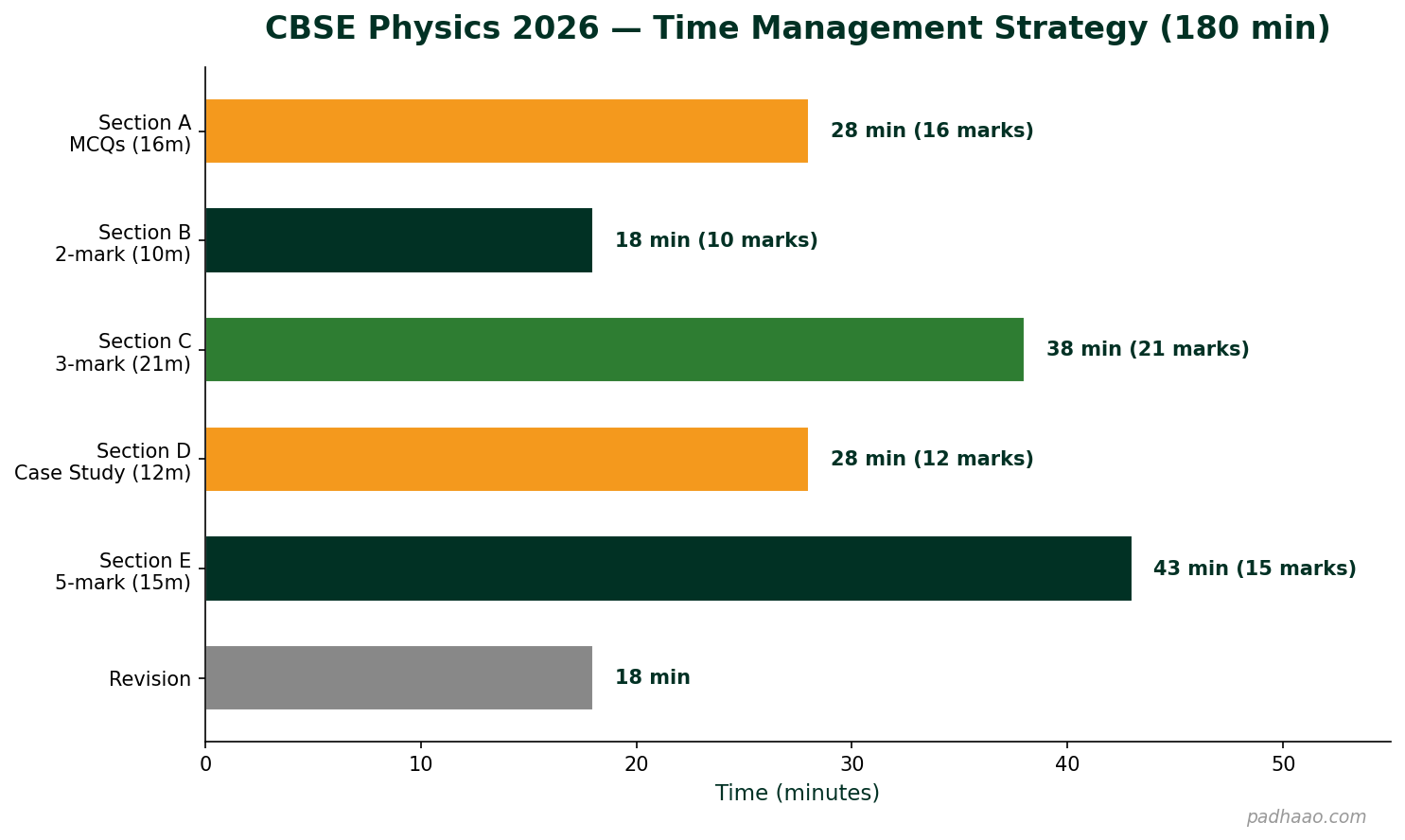 >
>Section-Wise Time Management Strategy
One of the biggest reasons students lose marks isn't knowledge — it's time. Here's a recommended time allocation for the 3-hour (180 minute) paper:
- Section A (MCQs): 25-30 minutes. Don't spend more than 1.5 minutes per MCQ. If stuck, mark it and move on.
- Section B (2-mark): 15-20 minutes. Quick recall questions. Write to the point — don't over-explain for 2 marks.
- Section C (3-mark): 35-40 minutes. Include diagrams where relevant. Show all steps in numericals — CBSE gives step marks.
- Section D (Case Study): 25-30 minutes. Read the passage carefully. Answers are often directly stated in the case study text.
- Section E (5-mark): 40-45 minutes. Start with the question you're most confident about. Always draw labelled diagrams for optics and circuit questions.
- Revision: Last 15-20 minutes. Check MCQ bubble sheet, verify numerical answers, ensure all questions attempted.
CBSE Marking Scheme — How Marks Are Awarded
Understanding the marking scheme gives you an edge. CBSE follows these rules:
- Step marking: In numerical problems, marks are given for each correct step — even if the final answer is wrong. Always show your working.
- Diagram marks: Labelled diagrams carry 0.5-1 mark in most questions. A well-drawn ray diagram or circuit diagram can save your score.
- Alternative methods: If you solve a problem using a different valid method, you still get full marks. CBSE accepts any correct approach.
- Units and significant figures: Writing correct SI units can be worth 0.5 marks. Don't skip units in your final answer.
- Derivation marks: For 5-mark derivations, marks are split: 2 for setup (diagram + assumptions), 2 for mathematical steps, 1 for final expression. Even if you can't complete the derivation, write whatever you can.
Most Important Topics for Scoring 60+/70
If you're targeting 60+ marks in Physics, focus your revision on these high-weightage, high-scoring topics:
- Electrostatics derivations: Electric field due to dipole, Gauss's law applications (16 marks unit — master this and you've covered 23% of the paper)
- Optics: Lens maker's equation, refraction through prism, Young's double slit experiment. Diagrams are key — a clear ray diagram can earn you 1-2 bonus marks.
- Electromagnetic Induction: Faraday's law derivation, AC generator working, transformer. EMI + AC circuits together carry 8-10 marks.
- Current Electricity numericals: Kirchhoff's law problems, meter bridge, potentiometer. Practice at least 20 numericals from these topics.
- Modern Physics: Photoelectric effect (Einstein's equation), de Broglie wavelength, nuclear binding energy. These are formula-heavy — memorize and apply.
Ready to take the next step?
Get personalised college recommendations, fee details, and admission tips — all in one free counselling session.
Common Mistakes to Avoid
- Skipping diagrams: Many students lose 2-3 marks per paper simply by not drawing diagrams. Even in numericals, a quick circuit diagram or ray diagram shows the examiner you understand the concept.
- Not writing formulas before solving: CBSE gives marks for stating the formula separately. Write it, then substitute values.
- Ignoring sign conventions in optics: Wrong signs in mirror/lens formula lead to wrong answers. Memorize the Cartesian sign convention.
- Spending too long on one MCQ: Each MCQ is worth 1 mark. If you spend 5 minutes on one, you're losing time for a 5-mark question worth more.
- Not attempting all questions: There's no negative marking in boards. Attempt everything — even a partially correct answer can get 1-2 marks.
How to Use This Question Paper for 2027 Preparation
If you're in Class 11 or early Class 12, here's how to use the 2026 paper effectively:
- First, try solving it as a mock test under timed conditions (3 hours, no notes)
- Mark the questions you couldn't solve — these are your weak areas
- Check the chapter weightage table above — prioritize high-weightage topics
- Practice similar questions from NCERT textbook examples and exercises
- Solve 2024 and 2025 papers too — look for repeating question patterns
Looking for online study options? Explore Online BCA and Online M.Sc courses after Class 12. For career guidance, check our Career Counselling page.
Conclusion
The CBSE Class 12 Physics 2026 paper was moderately difficult with strong NCERT alignment. Whether you're analysing your performance or preparing for next year, understanding the paper pattern, chapter weightage, and marking scheme gives you a strategic advantage. Download the official paper from cbseacademic.nic.in, practice under timed conditions, and focus on the high-weightage topics listed above.
Frequently Asked Questions
Where can I download the CBSE Class 12 Physics 2026 question paper PDF?
What was the difficulty level of CBSE Physics 2026 paper?
What is the chapter-wise weightage in CBSE Class 12 Physics?
How many marks are needed to score well in CBSE Physics?
Does CBSE give step marks in Physics?
Need college admission guidance?
Our counsellors have helped 2,000+ students with college selection, applications, and admission planning. Get free personalised guidance.
Recommended Articles
CBSE Full Form: Central Board of Secondary Education — Board, Exams & Affiliation

BBA Colleges in India Without Entrance Exam: Direct Admission Guide 2026

JEE Main 2026 Preparation: Complete Strategy, Study Plan & Subject-Wise Tips

How to Balance Work, Life & Online Studies: Time Management Tips for Professionals
CUET UG 2026: Exam Date, Syllabus, Pattern, Eligibility & Preparation Tips