Is Distance Learning Valid in India? UGC, AICTE & DEB Rules (2026)
Is distance or online degree valid for government jobs, UPSC, SSC, IBPS in 2026? Yes — if UGC-DEB approved + DEB-ID registered. Complete rules, verification steps & approved university list.
The biggest question every student asks before enrolling in a distance or online programme: Is distance learning valid in India? The short answer is yes — but only if the university and programme meet specific regulatory criteria set by the UGC (University Grants Commission), DEB (Distance Education Bureau), and AICTE (All India Council for Technical Education).
2026 Update: Starting from the 2024-25 academic session, every student enrolling in an ODL or online programme must generate a DEB-ID through the UGC-DEB portal using their ABC-ID (Academic Bank of Credit). Without a valid DEB-ID, your admission is not recognised — even if the university itself is UGC-approved. This is a major regulatory change that many students are unaware of.
This guide explains exactly what makes a distance or online degree valid, the new DEB-ID requirement, how to verify any university’s approval status, and what ‘valid’ means for government jobs, private sector hiring, competitive exams, and higher education in 2026.
Understanding India’s Education Regulators: UGC, DEB & AICTE
India’s distance and online education ecosystem is governed by three key regulatory bodies. Understanding what each does — and what each approves — is essential before enrolling in any programme:
UGC (University Grants Commission)
- The apex regulatory body for all higher education in India, established in 1956
- UGC grants recognition to universities, sets minimum standards for curriculum, faculty, and infrastructure
- A university must have UGC recognition to award valid degrees in India
- UGC maintains the list of ‘fake universities’ — always check this list before enrolling
- Website: ugc.gov.in
DEB (Distance Education Bureau)
- A bureau within UGC that specifically regulates distance and online education programmes
- Previously called DEC (Distance Education Council) — renamed to DEB in 2013
- DEB approves which universities can offer online and distance degrees, and which specific programmes are permitted
- A university being UGC-recognised does NOT automatically mean its online programmes are approved — DEB approval is a separate process
- DEB also sets standards for Learning Management Systems (LMS), exam patterns, and student support for online programmes
- New: DEB now manages the DEB-ID system — a unique lifetime identifier for every ODL/online student in India
- Website: deb.ugc.ac.in
AICTE (All India Council for Technical Education)
- Regulates technical and management education in India — engineering, MBA, MCA, pharmacy, architecture, hotel management
- For online MBA, MCA, and technical programmes, AICTE approval is required IN ADDITION to UGC-DEB approval
- AICTE sets curriculum standards, faculty requirements, and infrastructure norms for technical programmes
- A university can have UGC-DEB approval for online B.Com but still need separate AICTE approval for online MBA from the same university
- Website: aicte-india.org
The golden rule: A distance or online degree is valid in India when (1) the university has UGC recognition, (2) the specific programme has DEB approval for online/distance delivery, (3) for technical/management programmes, AICTE approval is additionally present, and (4) you have a valid DEB-ID linked to your enrolment. Missing any one of these makes the degree questionable.
 >
>UGC-DEB Rules for Online and Distance Education in 2026
The UGC (Open and Distance Learning & Online) Regulations, 2020 — and its subsequent amendments in 2022, 2023, and 2024 — form the legal framework for all distance and online education in India. Here are the key rules every student must know:
Rules for universities offering online programmes:
- Must be a UGC-recognised university (central, state, private, or deemed) with valid NAAC accreditation of 3.01 or above (equivalent to NAAC Grade A)
- 2026 Update: Universities with NAAC A grade (3.01+) or above can now offer up to 40% of their total programmes in online mode without requiring separate DEB approval for each individual programme (UGC circular, 2025). This has significantly expanded the number of valid online programmes from approved universities.
- Must have been in existence for at least 5 years with a track record of conventional education
- Must apply to UGC-DEB for approval to offer specific programmes in online mode — approval is programme-specific, not blanket
- Must have a functional Learning Management System (LMS) with: live class capability, recorded lectures, assignment submission, discussion forums, and e-library access
- Must conduct proctored exams — either online (with AI proctoring and identity verification) or at designated exam centres
- Must maintain a student-teacher ratio not exceeding 60:1 for online programmes
- Faculty teaching online programmes must be the same or equivalent to on-campus faculty
- Approval is granted for 5 years, subject to periodic review and renewal
- Universities must submit annual reports to DEB on student enrollment, pass rates, and infrastructure updates
Rules for students (what makes YOUR degree valid):
- The university must appear on the latest UGC-DEB approved list (updated annually at deb.ugc.ac.in)
- Your specific programme (e.g., ‘Online MBA’ or ‘Online BCA’) must be listed under that university’s approved offerings — generic university approval is not sufficient
- You must have a valid DEB-ID — generated through the UGC-DEB portal using your ABC-ID before or at the time of admission
- The degree must be awarded directly by the university itself, not by a franchise partner, study centre, or affiliated institution
- You must have completed proctored exams as per UGC guidelines — degrees without proper examination are not valid
- The degree certificate must bear the university’s official seal and the registrar’s signature
How to verify (step by step):
- Visit deb.ugc.ac.in
- Navigate to ‘Recognised Institutions’ or ‘Online Programmes’
- Search for the university name
- Check if your specific programme is listed under that university’s approved programmes
- Verify the approval validity period — some approvals may have expired
If the university and programme appear on this list with a valid date, your degree is 100% legally valid for all purposes in India.
AICTE Rules for Online Technical and Management Programmes

For technical and management programmes, AICTE plays a critical additional regulatory role that many students overlook:
Programmes that need AICTE approval (in addition to UGC-DEB):
- Online MBA / PGDM: AICTE approval is essential for the MBA degree to be recognised by corporate employers and for MBA entrance exams. Without AICTE, some recruiters may not accept the degree for management positions
- Online MCA: AICTE recognition is needed for technical validity, especially if you plan to work in IT companies that verify technical credentials
- Online B.Tech / M.Tech: Very limited online offerings exist. Engineering programmes largely require campus attendance for lab work. Only a handful of universities have AICTE approval for online engineering
- Online PGDM (Post Graduate Diploma in Management): PGDM from standalone B-schools needs AICTE approval. Note: PGDM is different from MBA — PGDM is a diploma while MBA is a degree
Programmes that do NOT need AICTE approval:
- Online BBA, BCA, B.Com, BA, B.Sc — these are governed solely by UGC-DEB
- Online MA, M.Com, M.Sc — governed solely by UGC-DEB
- Distance B.Ed — governed by NCTE (National Council for Teacher Education) + UGC-DEB
- Online LLB/LLM — governed by BCI (Bar Council of India) + UGC-DEB
- Online nursing, pharmacy — governed by respective professional councils
2026 update on AICTE and online education:
AICTE has been increasingly progressive about online technical and management programmes since 2020. Key developments:
- AICTE's 'Approval Process Handbook 2025-26' explicitly includes provisions for online MBA and MCA programmes from approved universities
- Universities like NMIMS, Manipal, Amity, Chandigarh University, LPU, and Jain now have both UGC-DEB and AICTE approval for online MBA and MCA
- AICTE launched the SWAYAM platform for MOOCs (Massive Open Online Courses), signalling strong institutional support for online learning
- AICTE-approved online MBA programmes are increasingly accepted by the same companies that recruit from AICTE-approved campus programmes
Pro tip: When enrolling in an online MBA or MCA, always verify both UGC-DEB AND AICTE approval. Having only one of the two can create problems with certain employers or professional bodies.
DEB-ID: The New Mandatory Requirement for Online & Distance Students
This is the biggest regulatory change in distance education since 2020, and most students don’t know about it yet:
From the 2024-25 academic session onwards, every student enrolling in an ODL (Open and Distance Learning) or online programme must generate a DEB-ID — a unique, lifetime identifier that links your enrolment to the national Academic Bank of Credit (ABC) system.
What is DEB-ID?
- A unique identification number issued by the UGC Distance Education Bureau
- Generated through the UGC-DEB portal at deb.ugc.ac.in
- Requires your ABC-ID (Academic Bank of Credit ID) — if you don’t have one, create it first at abc.gov.in
- It’s a lifetime identifier — one DEB-ID per person, valid across all ODL/online programmes you ever enrol in
- Without a valid DEB-ID, your admission to any ODL/online programme is not recognised by UGC
How to create your DEB-ID (step by step):
- Create ABC-ID first: Visit abc.gov.in, register with your Aadhaar/DigiLocker, and generate your ABC-ID
- Visit DEB portal: Go to deb.ugc.ac.in and click on ‘Student Registration’ or ‘Create DEB-ID’
- Link ABC-ID: Enter your ABC-ID, personal details, and the university/programme you’re enrolling in
- Generate DEB-ID: Once verified, your unique DEB-ID is generated instantly
- Share with university: Provide your DEB-ID to the university during the admission process
Why does DEB-ID matter?
Critical: If your university did not collect your DEB-ID during admission, or if you enrolled without creating one, your degree may face validity challenges later — especially for government job applications where verification is strict. If you’re currently enrolled in an online/distance programme and don’t have a DEB-ID, create one immediately and submit it to your university.
The DEB-ID system serves two purposes: (1) it prevents students from being duped by unrecognised programmes (if the portal doesn’t let you generate a DEB-ID for a programme, it’s not approved), and (2) it creates a centralised national database of all ODL/online students, making degree verification instant for employers and government bodies.
Is Distance Education Valid for Jobs, Government Exams & Higher Studies?
This is the core question every prospective student asks — and the answer is legally clear, but practically nuanced:
For private sector jobs — YES, fully valid:
- All major IT companies (TCS, Infosys, Wipro, HCL, Cognizant, Tech Mahindra, Accenture) accept UGC-DEB approved online and distance degrees for hiring and promotions
- Big 4 consulting firms (Deloitte, EY, PwC, KPMG) hire candidates with online MBA degrees for analyst and associate roles
- Banking and financial services (HDFC, ICICI, Kotak, Bajaj) accept online degrees for officer and management positions
- E-commerce and tech companies (Amazon, Flipkart, Razorpay, Swiggy) increasingly focus on skills over degree mode
- A NASSCOM survey (2025) found that 78% of Indian IT companies treat online degrees at par with regular degrees for hiring, provided the university has valid UGC-DEB accreditation
- Most companies verify the university's UGC recognition during background checks — they do not separately verify whether the degree was earned online or on-campus
- The degree certificate from most universities does not mention 'online' or 'distance' — it bears the same seal and format as regular degrees
For government jobs — YES, legally equivalent:
The Supreme Court of India and multiple High Courts have upheld that UGC-DEB approved distance and online degrees are equivalent to regular degrees for government employment. Specifically valid for:
- UPSC Civil Services (IAS/IPS/IFS): Any graduation from a recognised university qualifies. Online degrees from UGC-recognised universities are explicitly accepted
- SSC CGL, CHSL, MTS: Accepts graduation from any recognised university, mode-agnostic
- IBPS PO, SBI PO, SBI Clerk: Bank recruitment accepts online and distance degrees from UGC-approved universities
- RBI Grade B: Accepts degrees from recognised universities without mode distinction
- State PSC exams: Most state public service commissions accept distance education degrees
- Teaching positions: B.Ed from NCTE-approved distance programme qualifies for teacher recruitment (TET, CTET, state TETs)
- Defence: CDS and NDA require degrees from recognised universities — distance degrees qualify
For higher education — YES, fully accepted:
- Online B.Com is valid for CA (ICAI), CS (ICSI), and CMA (ICMAI) registration
- Online BCA is valid for MCA admission at any university
- Online BBA is valid for MBA entrance exams (CAT, XAT, MAT, CMAT, GMAT)
- Online MBA qualifies you for Ph.D. admission in management
- Online degrees are valid for UGC NET and state-level SET exams for teaching eligibility
Is Distance Education Degree Valid for Government Jobs in India? (2026)
Yes — a distance education or online degree from a UGC-DEB approved university is fully valid for government jobs in India. This is not a grey area. The government has issued clear legal guidance on this, and multiple High Court and Supreme Court rulings have confirmed it.
The key document is the DoPT (Department of Personnel and Training) Office Memorandum, which states that degrees from distance education programmes approved by the relevant statutory authority (UGC-DEB, AICTE) are to be treated at par with regular mode degrees for the purpose of government employment. No recruiting authority can reject a candidate solely on the basis that the degree was earned through distance or online mode — provided the university is UGC-DEB approved and the programme is listed in their approved course directory.
Here is a recruitment-by-recruitment breakdown of exactly where your distance degree stands:
| Government Exam / Job | Distance Degree Accepted? | Condition | Commonly Asked For |
|---|---|---|---|
| UPSC IAS / IPS / IFS | Yes | Degree from a recognised university (online/distance qualifies) | Any graduation; MBA online valid for Civil Services |
| SSC CGL (Group B & C) | Yes | Graduation from a recognised university, any mode | B.Com, BBA, BA, B.Sc — distance mode accepted |
| SSC CHSL | Yes | 12th pass (some posts need graduation) from recognised board/university | Distance 12th via NIOS accepted; distance graduation accepted |
| IBPS PO / Clerk | Yes | Graduation from a UGC-recognised university, no mode restriction | B.Com, BBA, BA — distance valid at IBPS, SBI, RBI |
| SBI PO / SBI Clerk | Yes | Graduation from recognised university | SBI explicitly accepts distance degrees in their notification |
| RBI Grade B | Yes | Graduation (60% marks); mode not restricted | Distance graduation valid; online MBA valid for Phase 2 |
| Railway (RRB NTPC / Group D) | Yes | Graduation from recognised university for NTPC; 10th for Group D | Distance B.Com, BA, BBA commonly used for NTPC applications |
| State PSC (UPSC state level) | Yes (most states) | Almost all state PSCs accept distance degrees; verify each state's notification | UP PSC, MPSC, KPSC, TNPSC all accept UGC-DEB approved degrees |
| PSU Jobs (ONGC, BHEL, NTPC, SAIL) | Yes | Graduation from a recognised university; mode-agnostic at most PSUs | Some PSUs specify regular engineering only for technical roles — check individual notification |
| Teaching (TET / CTET / State TET) | Yes | B.Ed from NCTE-approved distance programme qualifies for TET eligibility | IGNOU B.Ed, MDU B.Ed commonly used for TET qualification |
| Defence (CDS / NDA) | Yes (CDS only) | CDS requires graduation from a recognised university — distance valid | NDA is for 12th pass; CDS accepts distance graduation |
| EPFO / ESI / Other Ministries | Yes | Follow DoPT OM — distance degrees at par with regular | Social Security Officer, Assistant, Inspector posts |
What Documents to Carry When Applying with a Distance Degree
When submitting your government job application with a distance or online degree, keep these ready. Some recruiters ask at the document verification stage:
- Degree certificate from your university — most do not mention "distance" or "online" on the certificate itself
- UGC-DEB approval letter or screenshot — download from the UGC-DEB website showing your university is on the approved list for your programme and your academic year
- NAAC accreditation certificate of your university (download from naac.gov.in)
- Marksheets / transcripts for each semester or year
- If asked to prove equivalence, cite the DoPT OM No. 1-1/2018-Estt(Pay-I) and the UGC Regulations 2017 on Distance Education
Which Distance Universities Are Most Accepted for Govt Jobs?
All UGC-DEB approved universities are legally equivalent. However, in practice, these names face zero scrutiny at document verification:
- IGNOU — central university, universally accepted with zero questions asked
- NMIMS Global Access — NAAC A+ rated, widely accepted
- Manipal University Online — established brand, high acceptance
- Amity Online — widely recognised for management and commerce roles
- LPU Online — accepted at most state and central recruitment
- Symbiosis Centre for Distance Learning (SCDL) — PGDM widely accepted by IBPS, SSC for management roles
Avoid universities that are newly added to the UGC-DEB list or have a history of being on the UGC "fake university" watchlist — even if currently approved, they can create unnecessary complications at verification.
When is a distance/online degree NOT valid?
- If the university is not on the UGC-DEB approved list for online/distance programmes
- If the specific programme is not approved (university is approved, but not for that particular course — this is a common trap)
- If the university's NAAC accreditation has expired or been downgraded below Grade A after your enrollment
- Degrees from unrecognised/fake universities (check the UGC fake university list annually)
- Degrees from foreign online universities not recognised by AIU (Association of Indian Universities) — this affects international online programmes
- Professional degrees where the regulatory body has not approved online delivery (e.g., MBBS, BDS cannot be done online)
Confused about which course to pick?
Our counsellors have helped 10,000+ students choose the right program. Get a free 15-minute call — no pressure, no sales pitch.
Top UGC-DEB Approved Online Universities in India (2026)
These universities have valid UGC-DEB approval, strong NAAC accreditation, and are verified safe choices for online and distance education in 2026:
| Universities | NAAC Grade | UGC-DEB | AICTE (MBA/MCA) | Popular Online Programmes | Fee Range (Annual) |
|---|---|---|---|---|---|
| DY Patil University Online | A++ | Yes | Yes | MBA, BBA, B.Com | INR 40K – 90K |
| Manipal University Online | A+ | Yes | Yes | MBA, MCA, BBA, BCA, B.Com, MA | INR 45K – 1.5L |
| Chandigarh University Online | A+ | Yes | Yes | MBA, MCA, BBA, BCA, B.Com, MA, M.Com | INR 30K – 1L |
For the complete list with detailed comparisons, read our guide: UGC Approved Distance Education Universities in India 2026.
Always verify the latest approved list on the official UGC-DEB website. Approval status can change annually — universities can be added or removed based on compliance reviews. Do not rely on third-party websites or the university's own claims without cross-checking the government database.
Ready to take the next step?
Get personalised college recommendations, fee details, and admission tips — all in one free counselling session.
How to Verify If Your Distance/Online Degree Will Be Valid
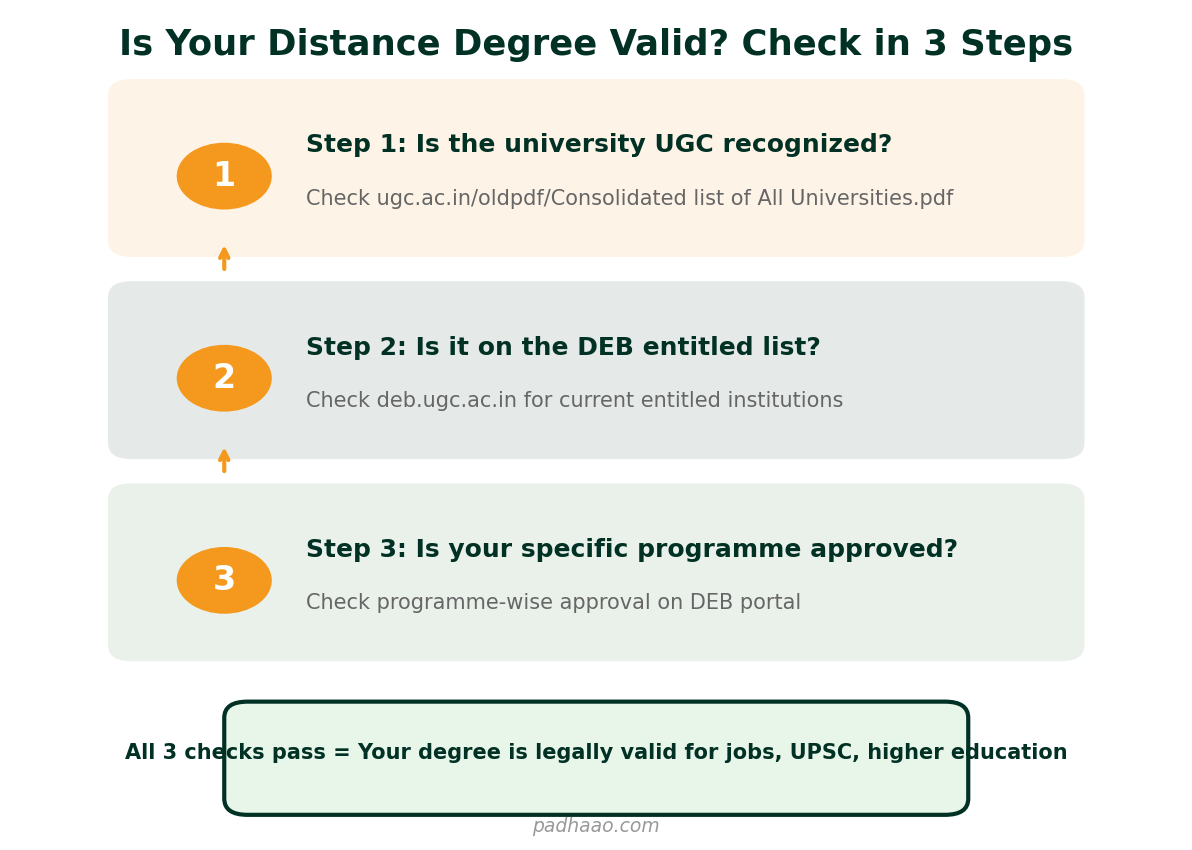
Before enrolling in any online or distance programme, follow this comprehensive 3-step verification to ensure your degree will be valid:
Step 1: Check UGC-DEB Approval (most critical)
- Visit deb.ugc.ac.in — this is the only authoritative source
- Navigate to 'Recognised Institutions' or search for 'Online Programmes' / 'ODL Programmes'
- Search for the university name exactly as it appears
- Verify that your specific programme (e.g., 'Online MBA', 'Online BCA') is listed under that university
- Check the approval validity dates — some universities have approvals that expired and are pending renewal
- Download or screenshot the approval document for your records
Step 2: Verify NAAC Accreditation
- Visit naac.gov.in
- Go to 'Accredited Institutions' or use the search function
- Search for the university and check: (a) NAAC grade (must be A or above = CGPA 3.01+), (b) validity period (accreditation expires — check the end date), (c) cycle of accreditation (higher cycles indicate longer track record)
- If NAAC has expired, the university technically should not be accepting new students for online programmes until re-accreditation
Step 3: Check AICTE Approval (only for MBA/MCA/Technical)
- Visit aicte-india.org
- Search under 'Approved Institutions' for the university
- This step is only needed for MBA, PGDM, MCA, and engineering programmes — skip for BBA, BCA, B.Com, BA, MA, etc.
Red flags that indicate potential invalidity:
- 'UGC recognised' but no DEB mention: The university may be UGC recognised for campus programmes but not approved for online delivery — these are different approvals
- Programme not listed on DEB website: The university is approved but your specific programme is not — your degree from that programme will be questionable
- Extremely low fees (under INR 5,000/year) from private universities: Legitimate online programmes have minimum infrastructure costs. Suspiciously cheap programmes may not have proper approvals
- No LMS or virtual classroom: UGC regulations mandate a functional LMS. If the university only sends printed materials with no online component, verify its DEB approval status
- Degree awarded by a partner/franchise: The degree must come from the university directly. If a study centre, coaching institute, or franchise partner claims to award the degree 'on behalf of' the university, verify directly with the university's registrar office
- No proctored exams: UGC mandates proctored examinations for online programmes. If a university claims you can complete the degree with only assignments and no exams, the degree may not be valid
- University on UGC 'fake university' list: Check the list at ugc.gov.in annually — it is updated regularly
When in doubt, take 10 minutes to verify on the official government websites. Those 10 minutes can save you 3 years of wasted effort and money on an invalid degree.
Looking for specific university reviews? Check our detailed guides on Sikkim Manipal Online MBA, LPU Online BBA, and VGU vs LPU comparison.
UGC-DEB 2026-27 Academic Year — Latest Updates
As of August 2026, here are the key changes and updates for the current academic session:
| Update | Details | Impact on Students |
|---|---|---|
| DEB-ID mandatory | Every ODL/online student must have a DEB-ID linked to ABC-ID | No DEB-ID = admission not recognised. Create immediately if you haven’t. |
| 113+ universities approved | 113+ universities now authorised for online programmes; 101+ for ODL mode | More choices than ever, but verify programme-level approval — not just university |
| 57 online-mode universities | 57 universities specifically approved for fully online degree programmes | Online mode (fully digital) is different from ODL (may have some physical components) |
| 40% programme cap relaxed | NAAC A+ universities can offer up to 40% of programmes online without per-programme DEB approval | Universities like LPU, CU, Amity can launch new online programmes faster |
| Annual renewal required | DEB entitlement is session-wise — universities must renew each year | Always check the current year’s list, not last year’s. A 2025-26 approval doesn’t guarantee 2026-27. |
| Professional courses restricted | Engineering (B.Tech), Medical (MBBS/BDS), Law (LLB), Architecture cannot be offered in distance/online mode | If anyone offers these online, it’s NOT valid. No exceptions. |
How to check the latest approved list:
- Visit deb.ugc.ac.in
- Look for ‘Entitled Institutions’ or ‘Recognised HEIs’ for the current session (2026-27)
- Download the PDF list — it’s updated at the start of each academic year
- Cross-check your specific programme under the university’s approved offerings
Important reminder: Approval is programme-specific AND session-specific. A university approved for online MBA in 2025-26 may or may not be approved for 2026-27. Always verify before paying fees.
Conclusion
Distance and online learning is fully valid in India — when you choose the right university. The three checkpoints are simple: (1) UGC-DEB approval for the specific programme, (2) valid NAAC accreditation, and (3) the university's inclusion in the latest UGC-DEB approved list. Meet these criteria, and your online degree carries the same legal weight as a regular degree for every purpose — jobs, promotions, government exams, and higher studies. Always verify before enrolling, and use Padhaao's university comparison tool to see accreditation details for every online university in India.
Frequently Asked Questions
Is distance learning valid for government jobs in India?
Yes. The Supreme Court of India has upheld that UGC-DEB approved distance and online degrees are equivalent to regular degrees. They are valid for UPSC, SSC, IBPS, RBI, state PSC, and all government positions that require a degree qualification.
Is online degree valid for CA registration?
Yes. ICAI (Institute of Chartered Accountants of India) accepts online and distance B.Com and BBA degrees from UGC-DEB approved universities for CA registration and as the graduation requirement alongside CA qualification.
What is the difference between UGC approved and UGC-DEB approved?
UGC recognition means the university is a valid Indian university. UGC-DEB approval means the specific online or distance programme offered by that university has been separately approved for delivery in online/distance mode. A university can be UGC recognised but not have DEB approval for online programmes. Always check DEB approval specifically.
Is NAAC A++ better than NAAC A+?
Yes. NAAC grades from highest to lowest are: A++ (3.76–4.00), A+ (3.51–3.75), A (3.01–3.50), B++ (2.76–3.00), B+ (2.51–2.75), B (2.01–2.50), C (1.51–2.00). For online programmes, UGC requires a minimum of 3.01 (Grade A). Universities with NAAC A++ (like LPU, DY Patil) or A+ (like Manipal, Amity, Chandigarh) exceed this threshold significantly.
Can I do MBA online? Is it valid?
Yes. Online MBA from UGC-DEB and AICTE approved universities is fully valid. Universities like NMIMS, Manipal, Amity, Chandigarh, LPU, and Jain offer approved online MBA programmes. The degree is valid for jobs, promotions, and further education.
Confused about distance learning programmes?
Our counsellors help you compare programmes, verify UGC-DEB approval, and choose the right university for your career goals. 100% free.
Recommended Articles

UGC Approved Distance Education Universities in India 2026: Complete List

How to Compare Online and Distance Education Programs in India Effectively

Top 10 Online BA Courses in India: UGC-Approved Degrees 2026

Top 5 Online Universities in India 2026: Ranks, Fees & Reviews

CU Online BBA – Build Your Business Skills with 25 Specializations