Online MBA vs Regular MBA: Which Is Better in 2026?
Online MBA vs Regular MBA — compare fees, placements, salary, ROI, and career outcomes. Data-backed guide to help you choose the right MBA in 2026.

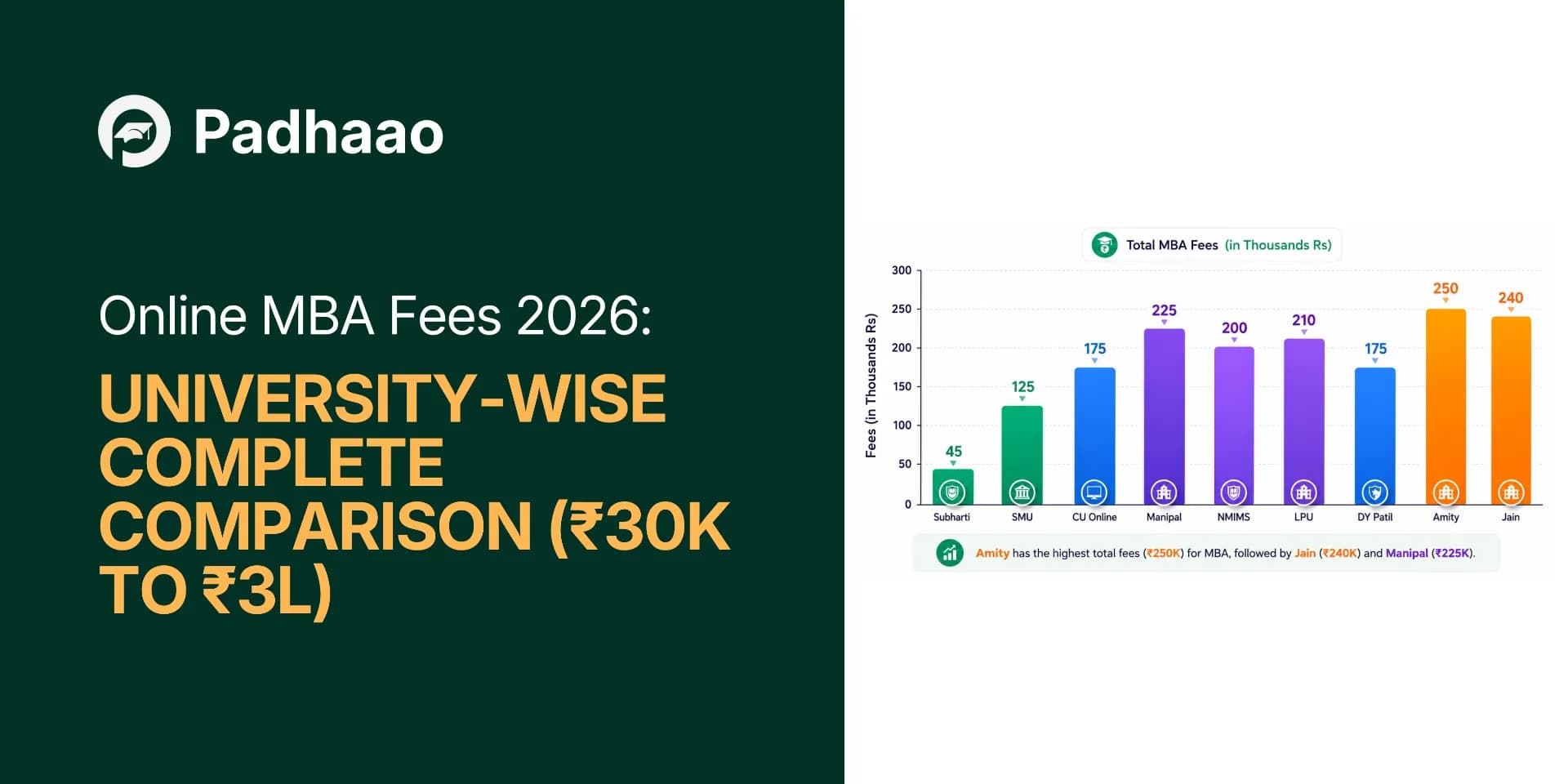
Choosing between an online MBA and a regular MBA is one of the biggest career decisions Indian professionals face in 2026. With UGC-DEB approved online MBA programmes now offered by NMIMS, Manipal, Amity, and other top universities — at 60–80% lower fees than full-time MBA — the decision is no longer straightforward. This guide compares every factor that matters: fees, eligibility, learning quality, placements, salary outcomes, and long-term ROI. Whether you are a working professional considering an MBA distance education programme or a fresher weighing campus life against flexibility, this comparison will help you make a data-backed decision.
Understanding
 >
>Online MBA vs Regular MBA
An online MBA (also called distance MBA or MBA distance education) is a UGC-DEB approved postgraduate management degree delivered through live virtual classrooms, recorded lectures, online assignments, and proctored exams. You study from anywhere — home, office, or while travelling — without attending a physical campus.
A regular MBA (full-time or on-campus MBA) requires 2 years of physical attendance at a university campus with daily classes, group projects, internships, and campus placements.
The critical point: both degrees are legally equivalent when from UGC-recognised universities. The MBA degree certificate does not mention 'online' or 'regular' at most institutions. The differences are in how you learn, what you pay, and what support you receive.
In 2026, the online MBA landscape has matured significantly. Universities like NMIMS, Manipal, Amity, Chandigarh University, and LPU now offer online MBA programmes with robust LMS platforms, live interactive sessions, industry mentorship, and even virtual placement support. The stigma around online degrees has largely disappeared among employers — a recent NASSCOM survey found that 78% of Indian IT companies treat online MBA degrees at par with regular MBA for hiring and promotions, provided the university has valid UGC-DEB accreditation.
This guide examines every dimension of the online MBA vs regular MBA debate — fees, eligibility, curriculum, placements, salary, ROI, and career outcomes — so you can make a data-backed decision based on your specific situation rather than outdated perceptions.
Eligibility and Admission: Online MBA vs Regular MBA
- Entrance exams required — CAT (for IIMs and top B-schools), XAT (for XLRI, XIME), MAT (for mid-tier colleges), GMAT (for international programmes), CMAT (for AICTE-affiliated colleges), or university-specific tests
- Cut-off scores: IIMs require 95+ percentile in CAT; top private B-schools require 80-90 percentile; mid-tier colleges accept 50-70 percentile
- Group Discussion (GD) and Personal Interview (PI) rounds at top colleges — these can be elimination rounds
- Writing Ability Test (WAT) at IIMs and some top colleges
- Minimum 50% in graduation from any recognised university (any discipline)
- Work experience: IIMs prefer 2–5 years; top private B-schools prefer 1+ years; mid-tier colleges accept freshers
- Admission cycle: CAT in November → results in January → GD/PI in February-April → admission offers in May → classes start in June/July
- Total process: 8-12 months from exam registration to class commencement
Step-by-Step
Admission Process — Educational Insights (2026)
Check Eligibility
Typically requires a Bachelor's degree (any stream) with min. 50% marks. Work experience is a plus for executive programs.
Fill Application Form
Submit the online form with personal details, academic records, and work experience. Most universities accept applications year-round.
Upload Documents
Mark sheets, degree certificate, ID proof, passport photo, and work experience letter (if applicable).
Pay Fees & Confirm Seat
Pay the initial semester/year fees online to confirm your seat. Many universities offer EMI options.
Regular MBA admission:

- Entrance exams required — CAT (for IIMs and top B-schools), XAT (for XLRI, XIME), MAT (for mid-tier colleges), GMAT (for international programmes), CMAT (for AICTE-affiliated colleges), or university-specific tests
- Cut-off scores: IIMs require 95+ percentile in CAT; top private B-schools require 80-90 percentile; mid-tier colleges accept 50-70 percentile
- Group Discussion (GD) and Personal Interview (PI) rounds at top colleges — these can be elimination rounds
- Writing Ability Test (WAT) at IIMs and some top colleges
- Minimum 50% in graduation from any recognised university (any discipline)
- Work experience: IIMs prefer 2–5 years; top private B-schools prefer 1+ years; mid-tier colleges accept freshers
- Admission cycle: CAT in November → results in January → GD/PI in February-April → admission offers in May → classes start in June/July
- Total process: 8-12 months from exam registration to class commencement
- No entrance exam at most universities — merit-based direct admission based on graduation marks and work experience
- Some premium programmes (NMIMS, Manipal) may have a brief online aptitude test or interview, but these are non-eliminatory
- Minimum 50% in graduation from any recognised university (any discipline)
- Work experience: Not mandatory at most universities. However, many students have 1-15+ years of professional experience
- Rolling admissions — apply anytime during the January or July admission window
- Fully online application: register → upload documents → pay fees → receive LMS credentials within 3-7 days
- Total process: 1-2 weeks from application to class start
Online MBA admission:
- No entrance exam at most universities — merit-based direct admission based on graduation marks and work experience
- Some premium programmes (NMIMS, Manipal) may have a brief online aptitude test or interview, but these are non-eliminatory
- Minimum 50% in graduation from any recognised university (any discipline)
- Work experience: Not mandatory at most universities. However, many students have 1-15+ years of professional experience
- Rolling admissions — apply anytime during the January or July admission window
- Fully online application: register → upload documents → pay fees → receive LMS credentials within 3-7 days
- Total process: 1-2 weeks from application to class start
The admission barrier for online MBA is significantly lower. You do not need months of entrance exam preparation, and there is no risk of 'not clearing' the cut-off. This accessibility is a genuine advantage for working professionals who cannot dedicate 6-8 months to exam preparation while managing their careers. However, the lower barrier also means online MBA cohorts are less selectively filtered than regular MBA batches at top B-schools.
Fees Comparison: Online MBA vs Regular MBA
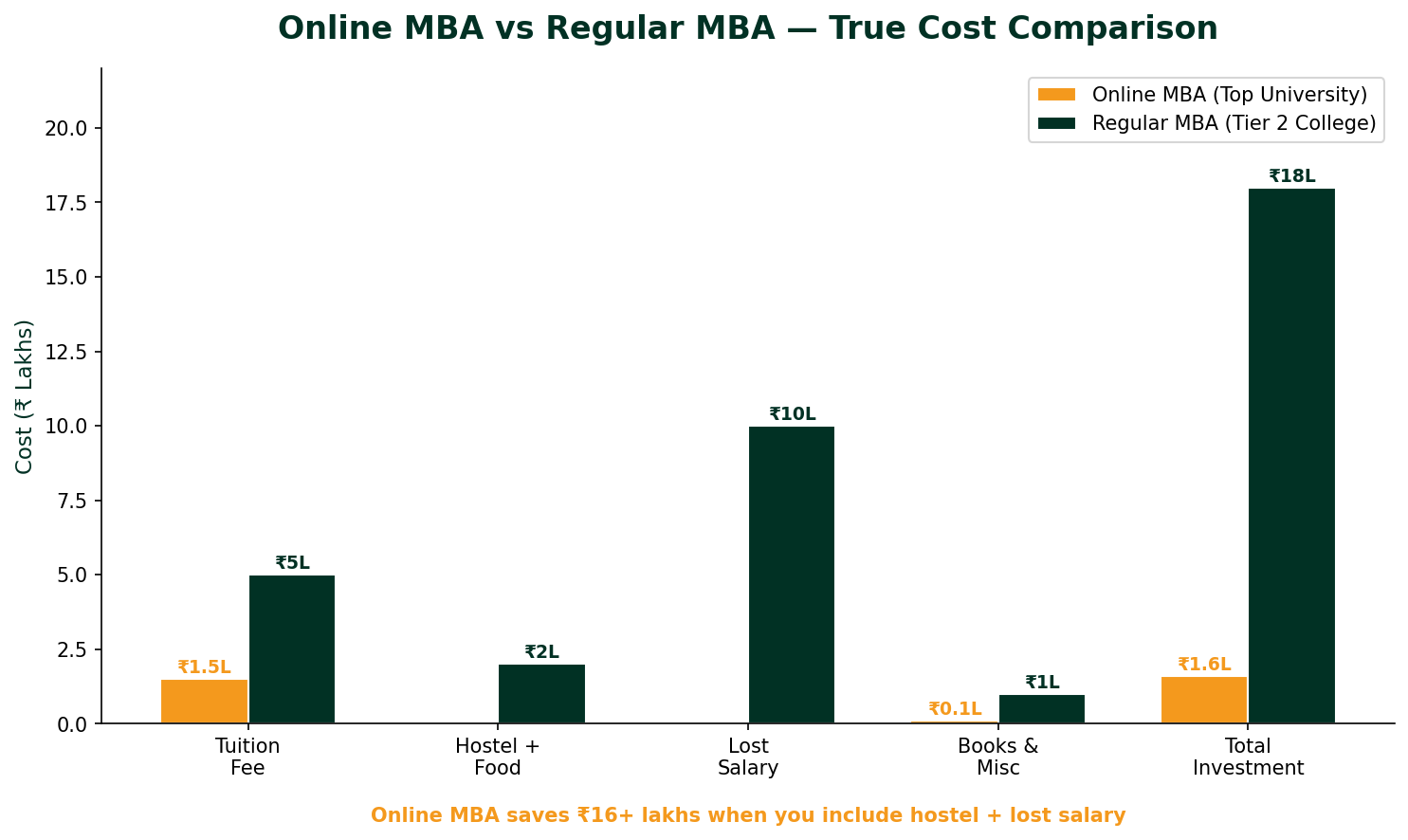
Beyond tuition, regular MBA carries substantial hidden costs that most comparison guides overlook:
- Hostel fees: INR 1–3 LPA per year at private B-schools (INR 2–6 LPA over 2 years)
- Food and living expenses: INR 50,000–1,00,000 per year
- Books and study materials: INR 10,000–30,000 per year
- Transportation: INR 20,000–50,000 per year for day scholars
- Opportunity cost (the biggest factor): A working professional earning INR 6 LPA loses INR 12 LPA in salary over 2 years. Someone earning INR 10 LPA loses INR 20 LPA
When you add all costs together:
| Cost Component | Regular MBA (Top Private) | Online MBA (Same University) |
|---|---|---|
| Tuition | INR 12–22 LPA | INR 1.5–3.5 LPA |
| Hostel + Living | INR 3–6 LPA | INR 0 |
| Books + Misc | INR 0.5–1 LPA | INR 0 |
| Opportunity Cost (salary lost) | INR 8–20 LPA | INR 0 (you keep working) |
| Total Real Cost | INR 23.5–49 LPA | INR 1.5–3.5 LPA |
This is the true cost comparison. A regular MBA from a top private B-school costs INR 25-50 LPA in real terms, while online MBA costs INR 1.5-3.5 LPA. The ROI calculation becomes clear: online MBA students need only a modest 15-20% salary increase to break even within the first year, while regular MBA students may need 3-5 years to recover their total investment (unless they land a top campus placement package).
Fee Comparison
Estimated Fee Structure — Educational Insights (2026)
2 Years
2 Years
2 Years
Learning Experience and Curriculum
- In-person lectures (4-6 hours daily) with direct faculty interaction, spontaneous debates, and Q&A sessions
- Campus life — student clubs (finance, marketing, consulting), cultural events, business competitions (case studies, B-plan), sports
- Summer internship (mandatory 2-3 months between Year 1 and Year 2) — provides real industry experience and often converts to a full-time offer
- Group projects with classmates from diverse professional backgrounds — a major learning channel in MBA
- Guest lectures from industry leaders, alumni sessions, and corporate networking events on campus
- Library access, computer labs, Bloomberg terminals (at top B-schools), and dedicated study spaces
- Peer network: you build relationships with 60-300 batchmates over 2 years of daily interaction — this network is often cited as the most valuable MBA asset
Confused about which course to pick?
Our counsellors have helped 10,000+ students choose the right program. Get a free 15-minute call — no pressure, no sales pitch.
Regular MBA learning experience:
- In-person lectures (4-6 hours daily) with direct faculty interaction, spontaneous debates, and Q&A sessions
- Campus life — student clubs (finance, marketing, consulting), cultural events, business competitions (case studies, B-plan), sports
- Summer internship (mandatory 2-3 months between Year 1 and Year 2) — provides real industry experience and often converts to a full-time offer
- Group projects with classmates from diverse professional backgrounds — a major learning channel in MBA
- Guest lectures from industry leaders, alumni sessions, and corporate networking events on campus
- Library access, computer labs, Bloomberg terminals (at top B-schools), and dedicated study spaces
- Peer network: you build relationships with 60-300 batchmates over 2 years of daily interaction — this network is often cited as the most valuable MBA asset
- Live virtual classes (typically 6-10 hours per week, scheduled on weekends or weekday evenings) via Zoom/Teams/proprietary platforms
- Recorded lectures uploaded to LMS within 24 hours — watch anytime, revisit as needed
- Case studies, assignments, and quizzes submitted digitally with defined deadlines
- Discussion forums and peer collaboration through online platforms, WhatsApp groups, and virtual study circles
- Industry webinars and guest lectures from business leaders — often the same speakers as regular MBA programmes
- Self-paced study with flexibility to adjust weekly hours based on work demands
- Virtual labs and simulation tools at some universities (Manipal, Amity) for practical application of concepts
- Peer network: online cohorts connect through structured group projects, LinkedIn groups, and virtual meetups — less organic than campus but increasingly effective
Online MBA learning experience:
- Live virtual classes (typically 6-10 hours per week, scheduled on weekends or weekday evenings) via Zoom/Teams/proprietary platforms
- Recorded lectures uploaded to LMS within 24 hours — watch anytime, revisit as needed
- Case studies, assignments, and quizzes submitted digitally with defined deadlines
- Discussion forums and peer collaboration through online platforms, WhatsApp groups, and virtual study circles
- Industry webinars and guest lectures from business leaders — often the same speakers as regular MBA programmes
- Self-paced study with flexibility to adjust weekly hours based on work demands
- Virtual labs and simulation tools at some universities (Manipal, Amity) for practical application of concepts
- Peer network: online cohorts connect through structured group projects, LinkedIn groups, and virtual meetups — less organic than campus but increasingly effective
The curriculum content is identical at the same university — both regular and online MBA cover corporate finance, marketing management, organisational behaviour, operations, strategy, business analytics, and elective specialisations. The academic rigour is meant to be equal; the difference is in delivery mode, the intensity of peer interaction, and the campus experience that regular MBA uniquely offers.
One area where online MBA is catching up rapidly: practical learning tools. Universities like Manipal offer virtual business simulations, Amity provides international webinar series with their London and Dubai campuses, and NMIMS incorporates Harvard Business School case studies into the online curriculum. The gap between online and offline learning quality has narrowed significantly since 2020.
| Factor | Regular MBA | Online MBA |
|---|---|---|
| Campus Placements | Yes — dedicated placement cell, on-campus recruiting drives, shortlisting and interview scheduling handled by college | Limited — career services, virtual drives at select universities (Manipal, CU, NMIMS). Most students leverage degree for internal promotions |
| Average Package (Mid-tier) | INR 5–12 LPA for freshers | INR 6–15 LPA post-MBA salary for working professionals |
| Salary Increase | 2–4x for career switchers; 50-100% for experienced professionals | 30–60% within 2 years of completion |
| Career Switch Success | High — internships + placements actively facilitate industry transitions | Lower — you drive your own career change; degree opens doors but you walk through them |
| Networking Quality | Very strong — 2 years of daily interaction builds lifelong connections | Growing — online alumni networks, LinkedIn groups, virtual cohort projects. Less organic but functional |
| International Opportunities | Exchange programmes, global immersions, international internships at top schools | Limited — some universities (Amity) offer international webinar series |
Placements and Career Outcomes
| Factor | Regular MBA | Online MBA |
|---|---|---|
| Campus Placements | Yes — dedicated placement cell, on-campus recruiting drives, shortlisting and interview scheduling handled by college | Limited — career services, virtual drives at select universities (Manipal, CU, NMIMS). Most students leverage degree for internal promotions |
| Average Package (Mid-tier) | INR 5–12 LPA for freshers | INR 6–15 LPA post-MBA salary for working professionals |
| Salary Increase | 2–4x for career switchers; 50-100% for experienced professionals | 30–60% within 2 years of completion |
| Career Switch Success | High — internships + placements actively facilitate industry transitions | Lower — you drive your own career change; degree opens doors but you walk through them |
| Networking Quality | Very strong — 2 years of daily interaction builds lifelong connections | Growing — online alumni networks, LinkedIn groups, virtual cohort projects. Less organic but functional |
| International Opportunities | Exchange programmes, global immersions, international internships at top schools | Limited — some universities (Amity) offer international webinar series |
Regular MBA has a clear edge in structured placements — the college placement cell does much of the work for you: inviting companies, scheduling interviews, negotiating offers. For fresh graduates or career switchers, this infrastructure is invaluable.
Online MBA's strength is different: it accelerates your existing career trajectory. Working professionals use the MBA credential plus their accumulated experience to negotiate promotions, switch departments, or move to higher-paying companies. A 2025 study by TimesJobs found that 67% of online MBA graduates reported a promotion or role change within 18 months of completing their degree, with an average salary increase of 42%.
The bottom line: if you need someone to place you in your first management job, regular MBA is clearly better. If you already have a career and want to accelerate it, online MBA delivers comparable or better ROI with dramatically lower cost and no career interruption.
Career Outcomes
Career & Placement Overview — Educational Insights Graduates
Average Package
₹8 – 15 LPA
Post-graduation median salary
Highest Package
₹25 – 45 LPA
Top offers from premium recruiters
Salary Hike
30 – 60%
Reported within 2 yrs of graduation
Hiring Partners
500+
Across industries & cities
Ready to take the next step?
Get personalised college recommendations, fee details, and admission tips — all in one free counselling session.
Who Should Choose Online MBA?
Online MBA is the clearly better choice if you fall into any of these categories:
- Working professionals with 2+ years of experience: The single largest group of online MBA students. You continue earning your salary (preserving INR 4-20+ LPA in income over 2 years) while adding an MBA qualification. Your existing experience + MBA creates a powerful combination for promotions and salary negotiations
- Mid-career professionals (5-15 years) seeking management roles: Many companies have an explicit or implicit requirement for an MBA for positions at the Senior Manager, Director, or VP level. Online MBA fulfils this without disrupting your career or family life
- Entrepreneurs and business owners: Running a business means you cannot take 2 years off. Online MBA teaches you finance, strategy, marketing, and operations frameworks that you can apply to your business in real-time as you learn them
- Parents and caregivers: If you have young children or family responsibilities, online MBA lets you study around your schedule — early mornings, late nights, or during nap times. No relocation, no hostel
- Budget-conscious students: If spending INR 10-25 LPA on a regular MBA is financially stressful, online MBA at INR 1-3 LPA gives you the same degree without debt burden. The ROI math is overwhelmingly in your favour
- Professionals in tier-2/tier-3 cities: If relocating to Delhi, Mumbai, or Bangalore for a campus MBA is not feasible, online MBA brings top university programmes to your hometown. You access the same Manipal or NMIMS curriculum regardless of your location
- Government employees seeking promotion: Many government departments consider MBA for promotion to senior positions. Online MBA lets you continue your government service while earning the qualification
Who Should Choose Regular MBA?
Regular MBA is the better choice in these specific scenarios:
- Fresh graduates with 0-2 years of experience: Campus placements, summer internships, and the structured job search process provide the best career launchpad when you do not have an existing professional network. The 2-year campus experience also builds soft skills, confidence, and professional maturity
- Career switchers: If you want to move from engineering to consulting, or from IT to FMCG marketing, the regular MBA placement process is designed for exactly this. Companies visiting campus specifically hire for cross-functional transitions. This is very hard to achieve through online MBA alone
- Those targeting top-tier packages (INR 15+ LPA): IIM/ISB/XLRI/FMS campus placements reach INR 20-50+ LPA. No online MBA programme matches these numbers through direct placements. If your primary goal is maximising immediate post-MBA salary, top B-school regular MBA is the path
- Students who thrive in classroom settings: Some people learn best through face-to-face interaction — real-time debates, body language, spontaneous discussions with peers during breaks. If self-directed online study feels isolating to you, regular MBA's immersive environment will be more effective
- Those seeking international exposure: Top B-schools offer student exchange programmes with global universities, international consulting projects, and overseas internships. These experiences are unique to full-time campus programmes
- Young professionals with family financial support: If your family can fund your regular MBA without creating financial stress, and you are under 28 with limited work experience, the campus MBA experience will likely generate higher lifetime returns through the network and placement access it provides
The Verdict: Which MBA Is Better in 2026?
Neither is universally 'better' — the right MBA depends on your specific situation. Here is a decision matrix:
| Your Situation | Better Choice | Why |
|---|---|---|
| Working professional, 3+ years experience | Online MBA | No career break, immediate ROI, keep earning while learning |
| Fresh graduate, no work experience | Regular MBA | Campus placements, internships, professional network building |
| Budget under INR 3 LPA total | Online MBA | Total cost INR 80K–2.5 LPA vs INR 15–50 LPA (with opportunity cost) |
| Want to switch career/industry entirely | Regular MBA | Structured placement cell facilitates industry transitions |
| Want to grow in current company/industry | Online MBA | Study + work simultaneously, apply MBA learnings immediately at work |
| Living in tier-2/3 city, cannot relocate | Online MBA | Access NMIMS, Manipal, Amity curriculum from anywhere |
| Have family/caregiving responsibilities | Online MBA | Flexible schedule, no relocation, study around your life |
| Entrepreneur running a business | Online MBA | Cannot close business for 2 years; apply learnings in real-time |
| Age 22-25, strong academic record | Regular MBA | Maximise the campus experience window; easier to do when younger |
The financial reality check: For most working professionals, the total cost comparison makes online MBA the obvious winner. A professional earning INR 8 LPA who takes 2 years off for regular MBA loses INR 16 LPA in salary + pays INR 10-20 LPA in fees = INR 26-36 LPA invested. The same professional doing online MBA pays INR 1.5-3 LPA and keeps earning. To justify regular MBA financially, the post-MBA salary would need to exceed INR 18-20 LPA — which only top 20 B-school placements can reliably deliver.
The career stage reality check: If you are a 25-year-old with 1-2 years of experience and no financial constraints, regular MBA offers lifetime returns through the campus network, internship experience, and placement process that compound over decades. The investment is high, but the compounding benefits are real.
How Padhaao Helps You Choose the Right MBA
At Padhaao, we help you navigate this decision with data, not opinions:
- NIRF-based university rankings: We compile and visualise official NIRF ranking data so you can compare universities using government-backed metrics, not marketing claims or paid rankings
- Fee comparison tool: See exact fees for 30+ online MBA programmes side by side, including EMI options, scholarships, and hidden costs that other portals do not disclose
- Free career counselling: Speak with our education advisors who understand both online and regular MBA landscapes. We help you evaluate your career stage, financial situation, and goals before recommending a path
- Admission support: From university shortlisting to document submission to fee payment — we handle the end-to-end admission process at no extra cost
- Student reviews and outcomes: Read verified reviews from current and past online MBA students to understand the real learning experience beyond marketing brochures
Ready to start your MBA journey? Explore all online MBA programmes on Padhaao or visit our college rankings page to compare universities with NIRF charts. Still unsure about online vs regular? Book a free counselling session with our team.
Explore Top Online MBA Universities on Padhaao
| University | NAAC | MBA Fees |
|---|---|---|
| Manipal University Online | A++ | ₹1.5L–3L |
| LPU Online | A++ | ₹1.8L–2.4L |
| Amity University Online | A++ | ₹2L–3L |
| NMIMS Online | A++ | ₹1.5L–2.5L |
| Chandigarh University Online | A+ | ₹1.5L–2L |
| Jain University Online | A++ | ₹2L–2.8L |
Compare all universities: Best Online MBA Colleges 2026 | MBA Fees Comparison | Online MBA Course Guide
Conclusion
There is no universally 'better' MBA — the right choice depends entirely on your career stage, financial situation, and goals. Online MBA delivers the best ROI for working professionals who want to upskill without a career break, while regular MBA offers unmatched campus experience and placement support for fresh graduates. Both degrees carry equal legal validity when from UGC-recognised universities. The key is choosing a programme that aligns with where you are today and where you want to be in 5 years. Use Padhaao's online MBA comparison tool to find the right programme for your profile.
Frequently Asked Questions
Is online MBA valid for jobs in India?
Yes. Online MBA from UGC-DEB approved universities is legally equivalent to a regular MBA degree. Companies like TCS, Infosys, Wipro, Deloitte, and Amazon accept online MBA degrees for hiring and promotions. The degree certificate does not mention 'online' at most universities.
Do companies accept online MBA for promotions?
Yes. Many companies — especially in IT, banking, and consulting — require an MBA for management-level positions. Online MBA from a recognised university fulfils this requirement. In fact, employers often value the fact that you earned the degree while working, as it demonstrates time management and commitment.
Which is better: online MBA or regular MBA for salary?
It depends on your starting point. Regular MBA from a top 20 B-school can lead to INR 12–25 LPA packages through campus placements. Online MBA typically results in 30–60% salary hikes for working professionals — meaning someone earning INR 8 LPA could reach INR 11–13 LPA within 2 years. For total ROI (salary increase minus fees), online MBA often wins due to dramatically lower costs and no lost income.
Can I do MBA distance education while working full-time?
Absolutely — that is the primary purpose of online MBA and MBA distance education programmes. Classes are scheduled on weekends or evenings (typically 8–10 hours per week). All lectures are recorded and available on the LMS for flexible access. Most working professionals complete online MBA without any impact on their job performance.
Is online MBA accepted for government jobs?
Yes. UGC-DEB approved online degrees are legally equivalent to regular degrees for all purposes, including government job applications and competitive exams. Online MBA qualifies you for UPSC, SSC, state PSC, and other exams that require a postgraduate management degree.
Not sure which MBA college to apply to?
Our counsellors have helped 2,000+ students shortlist colleges, prepare applications, and get into their target B-schools. Free guidance, no spam.
Recommended Articles

Online MBA Courses in India 2026: Fees, Eligibility & Top Colleges
10 Best Online MBA Colleges in India 2026: Fees, Rankings & Placements
Online MBA Placements 2026: Which College Actually Gets You a Job?

General MBA vs Specialized Online MBA: Which One Should You Choose?
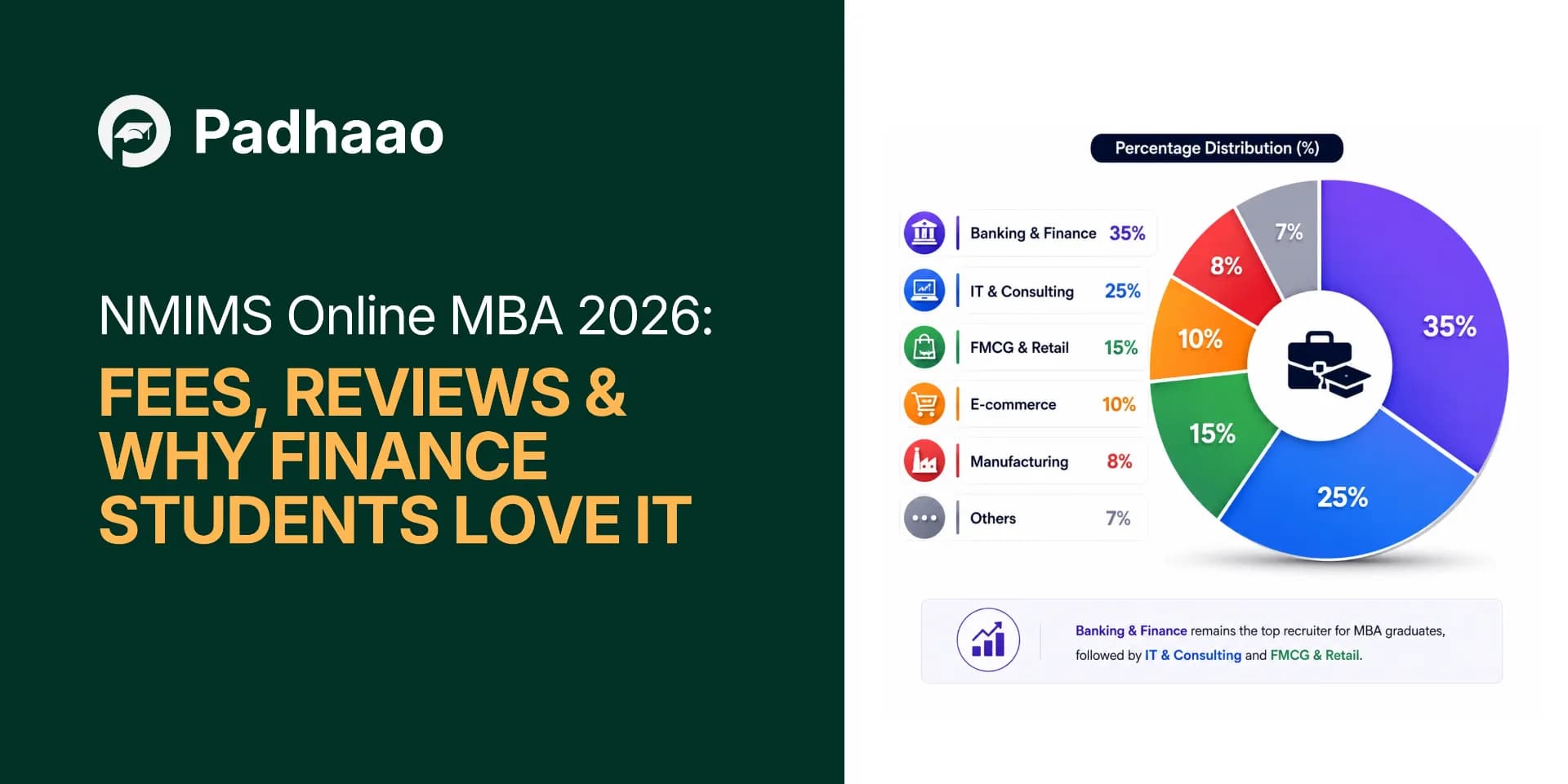
NMIMS Online MBA 2026: Fees, Reviews & Why Finance Students Love It