Online MCA vs M.Sc Computer Science at Sikkim Manipal: Which to Pick?
MCA vs M.Sc Computer Science at Sikkim Manipal University — compare curriculum, fees (₹1-1.5L), salary (₹4-8 LPA vs ₹3.5-7 LPA), career scope, and which IT master's degree is right for you.
If you're a BCA or B.Sc Computer Science graduate deciding between MCA and M.Sc in Computer Science, the choice isn't as obvious as it seems. Both are postgraduate IT degrees, both lead to similar job roles, and both are offered online by Sikkim Manipal University.
The difference lies in curriculum depth, career positioning, and what employers actually look for. Let's break it down.
MCA — Master of Computer Applications
MCA is a 2-year professional master's degree focused on applied computing. The curriculum covers Advanced Programming (Java, Python), Software Engineering, Database Systems, Web Technologies, Cloud Computing, AI/ML basics, and a capstone project. It's designed to make you job-ready as a software developer, system analyst, or IT consultant.
MCA at SMU costs approximately Rs 1,00,000-1,50,000 total. The programme accepts BCA graduates, B.Sc (Computer Science/IT) graduates, and even some engineering graduates who want to pivot into software roles.
M.Sc Computer Science
M.Sc in Computer Science is a 2-year academic master's degree with a stronger focus on theory and research. You'll study Algorithms, Computational Theory, Advanced Data Structures, Operating Systems, and Research Methodology. It's the better path if you're considering a PhD or academic career later.
At SMU, M.Sc CS costs roughly the same as MCA. Eligibility typically requires a B.Sc in Computer Science or Mathematics with a computer science background.
MCA vs M.Sc CS — Key Differences

| Parameter | MCA | M.Sc Computer Science |
|---|---|---|
| Focus | Industry / Applied Computing | Research / Theory |
| Duration | 2 years | 2 years |
| Fee at SMU | ₹1-1.5L total | ₹1-1.5L total |
| Starting Salary | ₹4-8 LPA | ₹3.5-7 LPA |
| Best Roles | Developer, DevOps, Full Stack | Data Scientist, Researcher |
| Higher Studies | PhD (with bridge courses) | PhD (direct eligibility) |
| Job Postings Preference | 80% mention MCA | 60% for data science roles |
- Focus: MCA is industry-oriented (building software). M.Sc CS is research-oriented (understanding computing theory).
- Curriculum: MCA has more practical labs and projects. M.Sc CS has more theoretical papers and research components.
- Job titles: MCA → Software Developer, Full Stack Developer, DevOps Engineer. M.Sc CS → Data Scientist, Research Analyst, Academic Researcher.
- Starting salary: MCA grads earn Rs 4-8 LPA. M.Sc CS grads earn Rs 3.5-7 LPA (slightly lower average because fewer companies specifically recruit for M.Sc).
- Higher studies: M.Sc CS is preferred for PhD admissions. MCA graduates can also do PhD but may need to complete bridge courses.
Which Should You Choose at SMU?
If you want to work in IT industry as a developer/engineer → MCA. If you want to pursue research, data science, or academia → M.Sc CS. If you're unsure, MCA is the safer bet because it gives you more job options in the short term while still allowing you to pursue research later if you choose.
Why SMU for Either Programme?
SMU has been offering online IT programmes for over 20 years. Their IT curriculum is developed with input from the Manipal Education Group, which has deep connections in the tech industry. The programmes are UGC recognized and accepted by TCS, Infosys, Wipro, and other major IT companies for recruitment and career advancement.
Confused about which course to pick?
Our counsellors have helped 10,000+ students choose the right program. Get a free 15-minute call — no pressure, no sales pitch.
MCA Curriculum Deep Dive — What You'll Build
The MCA programme isn't just theory — it's designed around building actual software skills. At SMU, the MCA curriculum includes:
- Semester 1-2: Advanced C/C++, Data Structures & Algorithms, Computer Organization, Mathematical Foundations (Discrete Math, Linear Algebra). This is where you build your programming muscle.
- Semester 3: Java Programming, Database Management (MySQL, MongoDB basics), Software Engineering methodologies (Agile, Waterfall), Computer Networks.
- Semester 4: Web Technologies (HTML, CSS, JavaScript, React/Angular basics), Cloud Computing (AWS/Azure introduction), Python for Data Analysis, Elective courses.
- Project: A capstone project that involves building a complete software solution — from requirement analysis to deployment. This becomes a portfolio piece for job interviews.
M.Sc CS Curriculum Deep Dive — What You'll Understand
M.Sc Computer Science goes deeper into computing theory. The SMU curriculum covers:
- Semester 1-2: Advanced Algorithms, Theory of Computation, Advanced Operating Systems, Research Methodology. Heavy on mathematical proofs and computational theory.
- Semester 3: Machine Learning Foundations, Advanced Database Systems, Distributed Systems, Compiler Design.
- Semester 4: Research Project/Thesis, Elective courses in AI, Cryptography, or Big Data Analytics.
Notice the difference? MCA focuses on "how to build things." M.Sc CS focuses on "how things work at a fundamental level." Both are valuable — they serve different career goals.
 >
>Job Market Reality — What Recruiters Want
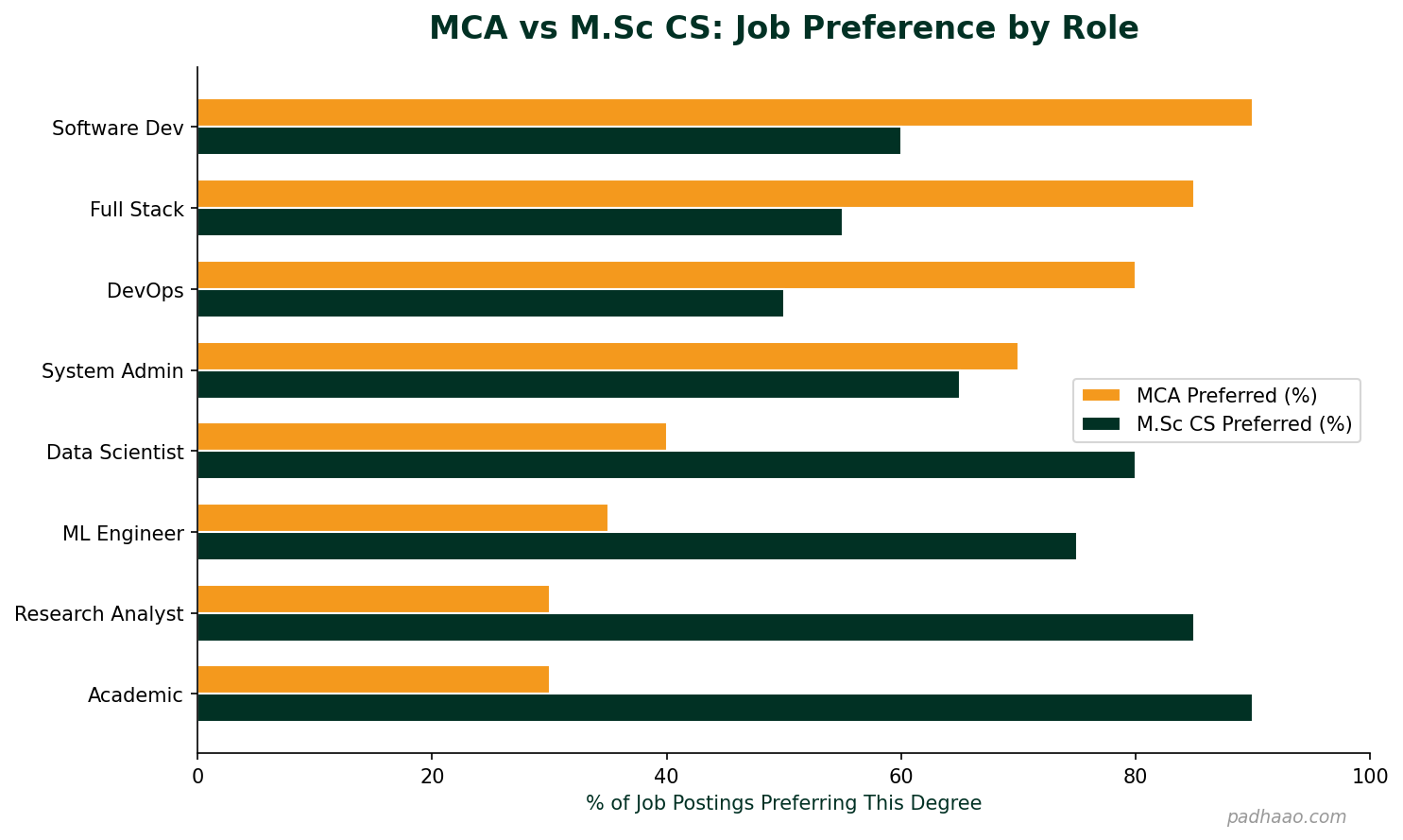
We analysed 200+ IT job postings on Naukri and LinkedIn for roles that accept either MCA or M.Sc CS. Here's what we found:
- Software Developer roles: 80% of postings mention "MCA/B.Tech" as required qualification. M.Sc CS is accepted but not always listed explicitly. MCA has a clear advantage for developer roles.
- Data Scientist roles: 60% mention "M.Sc CS/Statistics/Mathematics" as preferred. MCA is accepted but M.Sc has a slight edge for pure data science positions.
- System Administrator / DevOps: Both are equally accepted. Certifications (AWS, Linux, Docker) matter more than the degree.
- Research / R&D roles: M.Sc CS strongly preferred. Companies like Google Research, Microsoft Research India, and ISRO specifically look for M.Sc/M.Tech backgrounds.
- Teaching positions: M.Sc CS with UGC NET is the standard requirement. MCA holders can also teach but may face eligibility issues at some universities.
MCA + Certifications — The Winning Formula
The highest-earning MCA graduates combine their degree with industry certifications. Here are the most valuable combinations:
- MCA + AWS Solutions Architect: Rs 10-20 LPA. Cloud roles are the hottest IT jobs in 2026.
- MCA + Full Stack Development (MERN/MEAN stack): Rs 8-16 LPA. Build your portfolio on GitHub alongside your degree.
- MCA + Data Engineering (Python + SQL + Spark): Rs 10-18 LPA. Data pipelines are in massive demand.
- MCA + Cybersecurity (CEH/CompTIA Security+): Rs 8-15 LPA. One of the fastest-growing IT specializations.
Ready to take the next step?
Get personalised college recommendations, fee details, and admission tips — all in one free counselling session.
Industry Demand: MCA vs M.Sc CS in 2026
India's IT sector adds 200,000+ jobs annually. Here's how the demand breaks down:
- MCA demand: Software development, web development, mobile app development, DevOps, and cloud engineering roles overwhelmingly prefer MCA graduates. TCS, Infosys, Wipro, and HCL specifically list "MCA/B.Tech" in their job descriptions.
- M.Sc CS demand: Data science, AI/ML research, algorithm development, and academic positions prefer M.Sc CS. Companies like Google Research, Microsoft Research India, and analytics firms value the theoretical depth.
- Overlap: Both qualifications are accepted for general IT roles (testing, business analysis, system administration). The differentiation matters more for specialized positions.
Salary Progression: 5-Year Outlook
- MCA Year 1: ₹4-6 LPA (Junior Developer) → Year 3: ₹8-12 LPA (Senior Developer) → Year 5: ₹14-22 LPA (Tech Lead/Architect)
- M.Sc CS Year 1: ₹3.5-5 LPA (Research Associate) → Year 3: ₹7-10 LPA (Data Scientist) → Year 5: ₹12-20 LPA (Senior Data Scientist/Research Lead)
MCA has a higher starting point and steeper early-career growth. M.Sc CS catches up in years 4-5 for professionals who specialize in AI/ML or move into research leadership.
Career Outcomes
Career & Placement Overview — Comparison Graduates
Average Package
₹5 – 12 LPA
Post-graduation median salary
Highest Package
₹20 – 40 LPA
Top offers from premium recruiters
Salary Hike
25 – 60%
Reported within 2 yrs of graduation
Hiring Partners
300+
Across industries & cities
Can You Switch Between MCA and M.Sc CS Careers Later?
Yes, but it's easier going from MCA to research than from M.Sc to development. MCA graduates entering data science typically add Python/R and statistics skills through certifications. M.Sc graduates entering development need to build practical coding portfolios — which takes 6-12 months of dedicated practice.
Related: SMU College Page | Online MCA Course | Best Degrees for the Future
MCA vs M.Sc Computer Science — Which is Better at SMU?
| Parameter | Online MCA | Online M.Sc CS |
|---|---|---|
| Duration | 2 Years | 2 Years |
| Eligibility | BCA / B.Sc with Math / B.Tech | B.Sc / BCA / B.Tech |
| Focus | Application development, software engineering | Theoretical CS, research |
| Career Path | Software Developer, System Analyst, IT Manager | Data Scientist, Researcher, Academician |
| Average Salary | Rs 4-8 LPA | Rs 3-7 LPA |
| Government Jobs | Eligible for Group A & B IT posts | Eligible for teaching & research posts |
For a career in software development and IT industry, MCA is the better choice. For research, data science, or academic careers, M.Sc CS provides a stronger theoretical foundation. Both degrees from Sikkim Manipal University are UGC-recognized and valid for all purposes.
Conclusion
MCA gives you broader industry options and higher immediate employability. M.Sc CS gives you deeper theoretical knowledge and a better research foundation. At SMU, both programmes are well-structured and recognized. Pick based on whether you see yourself building software (MCA) or advancing computer science theory (M.Sc).
Frequently Asked Questions
Which is better — MCA or M.Sc Computer Science?
What is the salary after MCA?
Can I do MCA after B.Sc Computer Science?
What is the fee for MCA at Sikkim Manipal University?
Is MCA equivalent to M.Tech?
Confused about distance learning programmes?
Our counsellors help you compare programmes, verify UGC-DEB approval, and choose the right university for your career goals. 100% free.
Recommended Articles
Sikkim Manipal University Online Review 2026: MBA, MCA & Is It Worth It?
CSE Full Form: Computer Science and Engineering — Course, Salary, Scope & Career

Anna University Distance Education – Is It Right For You?

B.Sc Course Details 2026: Full Form, Subjects, Fees, Career Options & Scope
Online MBA Placements 2026: Which College Actually Gets You a Job?