How to Choose Between Skill-Based Courses and Full Online Degrees in 2026
Confused between skill-based courses and online degrees? Learn the key differences, hiring trends, and best career choice for 2026.
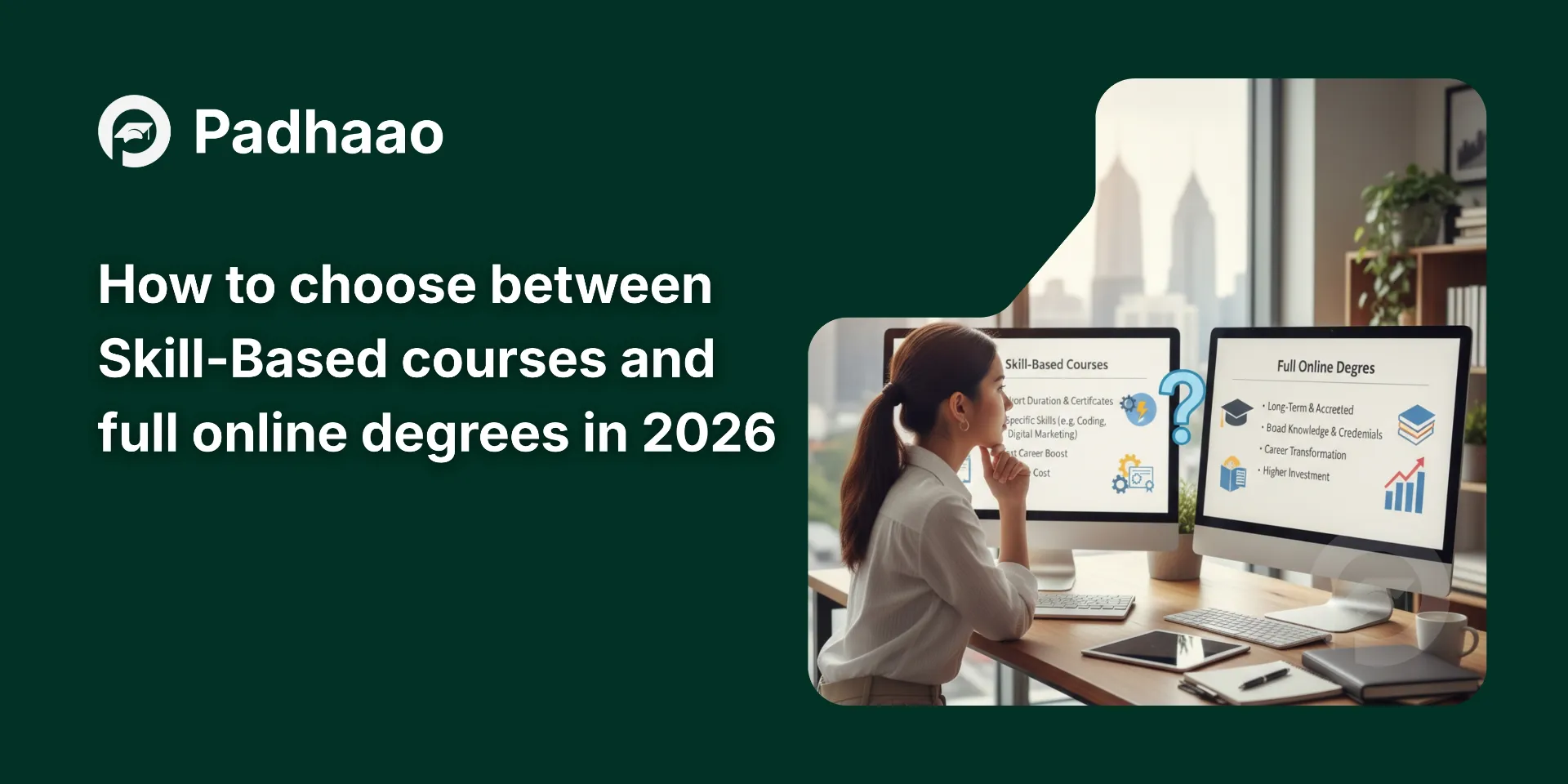
Choosing between skill-based courses and full online degrees can feel confusing. Many learners want fast job skills. Many also want strong educational qualifications. The question is important for career growth in 2026.
Employers focus more on both skills and education today. Job roles evolve fast in every industry. Skills help learners work better in modern jobs. Degrees help learners get formal recognition and career security.
This blog explains the degree vs skill debate and helps readers choose the best option for career growth.
Why the Decision Between Skills and Degrees Matters in 2026
The education-to-employment landscape in India is changing rapidly. Companies like Google, IBM, and TCS have started accepting skill certifications alongside traditional degrees for many roles. At the same time, government jobs, promotions, and academic positions still require formal degree qualifications.
Making the wrong choice can cost you years of effort and lakhs of rupees. Understanding what each path offers — and when to combine them — is crucial for maximizing your career outcomes in 2026.
Padhaao Tip: When comparing your options, weight this factor alongside your specific career goal. Our counsellors can tell you which of these applies to your situation — free consultation, 15 minutes.
The Current Job Market in 2026: Trends and Insights
The Indian job market in 2026 shows clear patterns:
- Tech sector: Skills-first hiring is dominant. Companies prioritize certifications in cloud computing, AI/ML, and data science over traditional degrees for technical roles.
- Management roles: MBA degrees remain the primary qualification for leadership positions in finance, consulting, and operations.
- Government sector: Formal degrees (UGC-recognized) are mandatory for most government positions and competitive exams.
- Startups: Portfolio and project-based skills often matter more than formal qualifications.
- Hybrid roles: Emerging roles in product management, growth hacking, and business analytics value both skills and degrees.
The safest career strategy often involves having both — a recognized degree for credibility and practical skills for employability.
Is Your Online Degree UGC-DEB Approved?
Our counsellors verify university approvals and help you choose a safe, valid online degree — for free.
Understanding Skill-Based Courses in 2026
Skill-based courses are short-duration programs (typically 2-12 months) that teach specific, job-ready skills. Popular platforms include Coursera, Udemy, Simplilearn, upGrad, and Great Learning. Common skill courses include:
- Digital Marketing Certification
- Data Science with Python
- Full Stack Web Development
- Cloud Computing (AWS/Azure/GCP)
- UI/UX Design
- Cybersecurity Fundamentals
These courses focus on practical application, often including hands-on projects, industry tools, and portfolio building. Completion typically earns a certificate rather than a formal degree.
Padhaao Tip: When comparing your options, weight this factor alongside your specific career goal. Our counsellors can tell you which of these applies to your situation — free consultation, 15 minutes.
Advantages and Limitations of Skill Courses
Advantages:
- Fast completion (weeks to months)
- Affordable (₹5,000 to ₹2 lakhs)
- Immediately applicable to current job
- Learn latest industry tools and technologies
- Flexible, self-paced learning
Limitations:
- No formal degree recognition
- Not valid for government jobs or competitive exams
- Certificate value varies by platform and employer
- May not qualify you for promotions requiring degree credentials
- Knowledge can become outdated quickly in fast-moving fields
Padhaao Tip: When comparing your options, weight this factor alongside your specific career goal. Our counsellors can tell you which of these applies to your situation — free consultation, 15 minutes.
Understanding Full Online Degrees in 2026
Full online degrees are UGC-DEB recognized academic programs (BBA, BCA, MBA, MCA, B.Com, MA) delivered entirely online by approved universities. These are legally equivalent to on-campus degrees and valid for all purposes — jobs, higher education, and government positions.
Duration ranges from 2-4 years for undergraduate programs and 1-2 years for postgraduate programs. Leading universities offering online degrees include Chandigarh University, Amity, Manipal, NMIMS, Jain University, LPU, and DY Patil.
Padhaao Tip: When comparing your options, weight this factor alongside your specific career goal. Our counsellors can tell you which of these applies to your situation — free consultation, 15 minutes.
Is Your Online Degree UGC-DEB Approved?
Our counsellors verify university approvals and help you choose a safe, valid online degree — for free.
Advantages and Limitations of Online Degrees
Advantages:
- Legally recognized and equivalent to on-campus degrees
- Valid for government jobs, competitive exams, and higher education
- Strong alumni networks and placement support
- Comprehensive curriculum covering fundamentals and advanced topics
- Long-term career credibility
Limitations:
- Longer duration (1-4 years)
- Higher cost (₹50,000 to ₹3.5 lakhs)
- May include theoretical content not directly applicable to current job
- Less focus on cutting-edge tools compared to skill courses
Padhaao Tip: When comparing your options, weight this factor alongside your specific career goal. Our counsellors can tell you which of these applies to your situation — free consultation, 15 minutes.
Side-by-Side Comparison
| Factor | Skill-Based Courses | Online Degrees |
|---|---|---|
| Duration | 2-12 months | 1-4 years |
| Cost | ₹5K - ₹2L | ₹50K - ₹3.5L |
| Recognition | Platform certificate | UGC-recognized degree |
| Government Job Validity | No | Yes |
| Job Readiness | Immediate | After completion |
| Career Switching | Good for tech roles | Good for management roles |
| Salary Impact | 10-25% increment | 30-50% increment |
| Long-term Value | Moderate (needs updating) | High (permanent credential) |
Online Certification vs Degree: Key Differences
The fundamental difference comes down to depth vs speed:
- Certifications prove you can do a specific task — like running Google Ads, building a React app, or analyzing data in Python. They are tactical and job-specific.
- Degrees prove you have comprehensive knowledge of an entire field — like business management, computer science, or commerce. They are strategic and career-spanning.
Think of certifications as tools in your toolbox and degrees as the foundation of your house. You need both for a strong career, but the order depends on your current situation.
Padhaao Tip: When comparing your options, weight this factor alongside your specific career goal. Our counsellors can tell you which of these applies to your situation — free consultation, 15 minutes.
Is Your Online Degree UGC-DEB Approved?
Our counsellors verify university approvals and help you choose a safe, valid online degree — for free.
Jobs: Skills vs Education
Different career stages and industries favor different approaches:
- Freshers (0-2 years): A degree provides the entry ticket. Add 1-2 skill certifications to stand out.
- Early career (2-5 years): Skill courses help you specialize and get promoted faster. An advanced degree (MBA/MCA) accelerates leadership growth.
- Mid career (5-10 years): An MBA opens doors to senior management. Specialized certifications keep you current in your domain.
- Career switchers: Start with skill courses to test the new field, then pursue a degree for formal qualification if needed.
Padhaao Tip: When comparing your options, weight this factor alongside your specific career goal. Our counsellors can tell you which of these applies to your situation — free consultation, 15 minutes.
The Strategy Used by Top Professionals
High-performing professionals use a "Degree + Skills" stacking strategy:
- Get the degree first: A recognized degree (BBA, MBA, BCA, MCA) provides the foundational credential and long-term career security.
- Add targeted skills: Layer 2-3 relevant skill certifications on top to become a specialist within your degree domain.
- Keep updating skills: Refresh your skill certifications every 1-2 years as technology and industry practices evolve.
For example, an Online MBA in Marketing + Google Ads Certification + HubSpot Inbound Marketing Certification creates a powerful profile for digital marketing leadership roles.
Padhaao Tip: When comparing your options, weight this factor alongside your specific career goal. Our counsellors can tell you which of these applies to your situation — free consultation, 15 minutes.
Should a Learner Pursue a Degree Even if Skilled?
Yes, in most cases. Here is why:
- Career ceiling: Without a degree, you may hit a promotion ceiling at mid-management level in many organizations.
- Salary negotiations: Degree holders consistently earn more in salary negotiations and annual appraisals compared to non-degree holders with similar skills.
- Job security: During layoffs and restructuring, formal qualifications provide an additional safety net.
- Global mobility: If you plan to work abroad, degrees are almost always required for work visa applications.
That said, if you are in a purely skills-driven field like freelance development or design, certifications and portfolio may suffice for most career goals.
Padhaao Tip: When comparing your options, weight this factor alongside your specific career goal. Our counsellors can tell you which of these applies to your situation — free consultation, 15 minutes.
Is Your Online Degree UGC-DEB Approved?
Our counsellors verify university approvals and help you choose a safe, valid online degree — for free.
How Padhaao Helps Learners Balance Both
Padhaao.com helps learners make smart education decisions:
- Career assessment: Our counselors evaluate whether you need a degree, skill course, or both based on your career goals and current profile.
- University matching: We match you with UGC-approved online universities that align with your budget, schedule, and career aspirations.
- Course recommendations: We suggest complementary skill certifications to pair with your degree for maximum career impact.
- End-to-end support: From initial consultation to enrollment completion, our team guides you at every step.
Start your journey at Padhaao.com/courses and explore the best online programs for your career growth.
Padhaao Tip: When comparing your options, weight this factor alongside your specific career goal. Our counsellors can tell you which of these applies to your situation — free consultation, 15 minutes.
Top Online Universities to Consider
All universities below are UGC-DEB approved and consistently offer flexible online programmes suited to working professionals and fresh graduates.
| University | NAAC | Popular Programmes | Annual Fees (approx) | Mode |
|---|---|---|---|---|
| Manipal University Online | A++ | BBA, MBA, MCA | ₹1.3–2.0L | Online |
| LPU Online | A++ | MBA, BCA, B.Sc | ₹0.9–1.8L | Online |
| Chandigarh University Online | A++ | MBA, BBA, B.Com | ₹1.0–1.6L | Online |
| IGNOU | A | BA, B.Com, MBA | ₹0.1–0.5L | Distance |
| Amity Online | A+ | MBA, BBA, MCA | ₹1.5–2.5L | Online |
| Sikkim Manipal University | B++ | MBA, MCA, BBA | ₹0.8–1.4L | Distance/Online |
| NMIMS Global Access | A | MBA, BBA, B.Com | ₹1.0–2.0L | Distance |
Get Online University Shortlist
We'll match you to the best UGC-DEB approved online universities for your programme and budget.
Conclusion
Both options serve different career needs. Skill-based courses offer fast learning and job-ready knowledge. Online degrees offer long-term credibility and strong academic value. Choosing the right option depends on personal goals, learning style, and career plans. Some learners want quick job entry. Some want stable growth, promotions, or higher studies.
The best choice is the option that supports future plans, not just current trends. The right path should build skills, confidence, and long-term opportunities. Both skills and education matter in today’s career world. The strongest advantage comes when both work together.
Don’t wait to upgrade your skills. Begin learning immediately and move one step closer to better opportunities. Start Today
Explore Online Degree Options
| University | NAAC | Programmes |
|---|---|---|
| Manipal Online | A++ | MBA, BBA, BCA, MCA, BA, B.Com |
| LPU Online | A++ | MBA, BBA, BCA, MCA, BA, B.Com |
| Amity Online | A++ | MBA, BBA, BCA, MCA, BA, B.Com |
Best MBA Colleges | Top BBA Colleges | Top BCA Colleges | Is Online Degree Valid?
Frequently Asked Questions
Are skill-based courses better than degrees?
Skill courses are ideal for quick employment, while degrees support long-term professional growth.
Do companies prefer skills or degrees in 2026?
Employers value both: degrees for credibility and skills for performance.
Which option gives faster jobs?
Skill-based certifications typically result in quicker job placements.
Should I pursue a degree if I already have skills?
Yes. Degrees complement skills and enhance career growth, stability, and eligibility.
How can Padhaao help balance both?
Padhaao provides university comparisons, validation, and hybrid learning recommendations for the best career path.
Confused about which online programme to choose?
Our counsellors compare 200+ programmes on fees, UGC approval, placement support and career outcomes — so you decide with confidence.
Recommended Articles

CU Online BBA – Build Your Business Skills with 25 Specializations

How to Compare Online and Distance Education Programs in India Effectively

Top 10 Online BA Courses in India: UGC-Approved Degrees 2026
Online BBA vs BCA: Which Course is Better for Your Career in 2026?
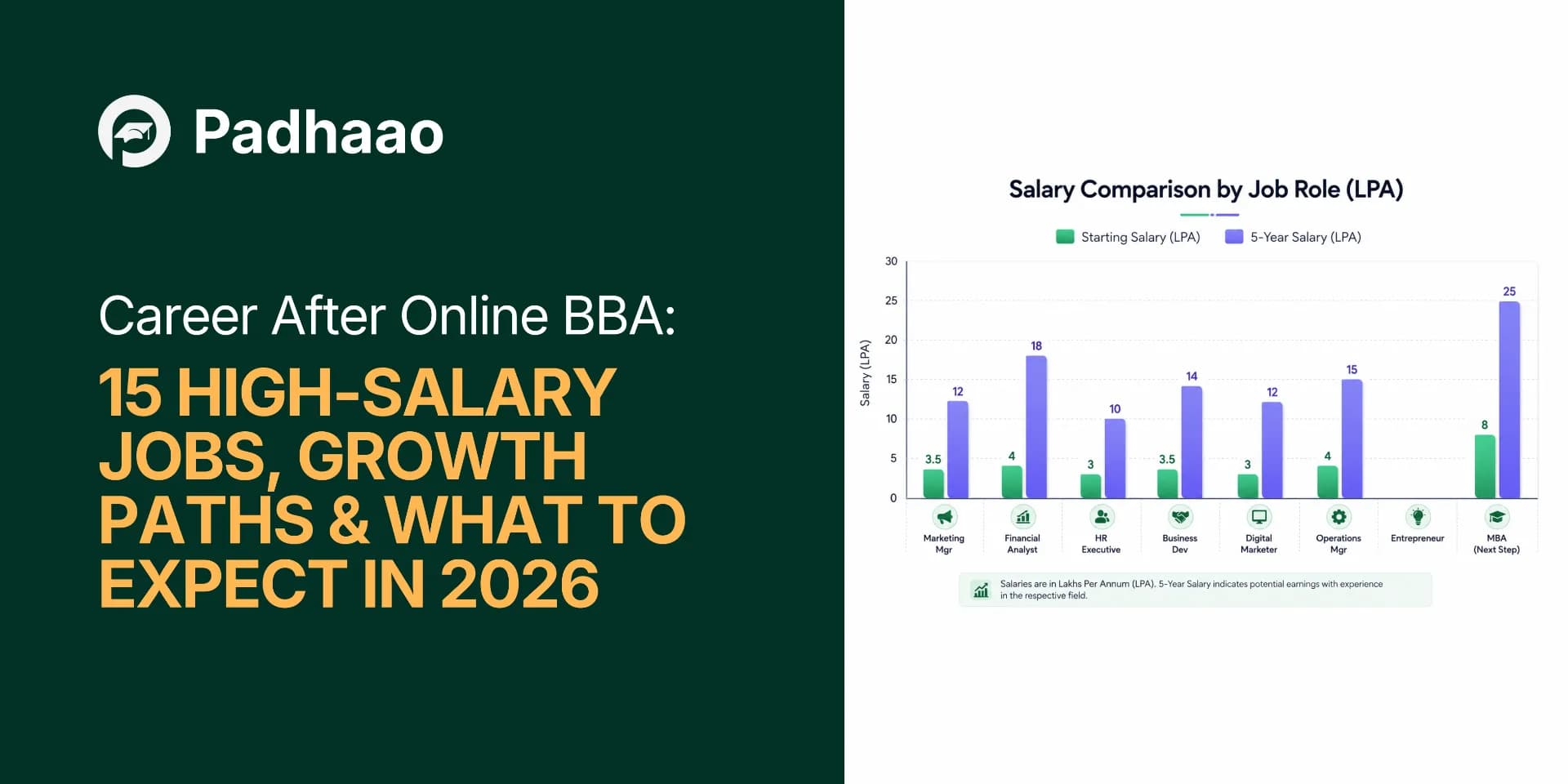
Career After Online BBA: 15 High-Salary Jobs, Growth Paths & What to Expect in 2026
![20 Best Courses & Degrees for the Future [2026-2030]: Salary, ROI & Career Paths](/_next/image?url=https%3A%2F%2Fstorage.padhaao.com%2Fpadhaao%2Fblogs%2F69773798aede295128af6db1%2F1772867857952_140.webp&w=3840&q=75)